Walmart SEO: How Search Ranking Works
Walmart Marketplace is no longer a secondary channel behind Amazon. In 2026, it is one of the most competitive retail search environments in the United States. If you want predictable sales on Walmart.com, you must understand how Walmart SEO works – not just keywords, but performance signals, fulfillment metrics, and conversion behavior.
At SwanseaAirport, we analyze Walmart listings weekly, audit seller catalogs, and test ranking variables across categories. This guide explains how Walmart search ranking actually works in 2026 – based on marketplace behavior, seller performance data, and hands-on optimization results.
This is not a theory. This is how you win visibility on Walmart today.
Understanding Walmart’s Search Algorithm (2026 Overview)
Walmart’s search engine ranks products using three primary signal groups:
- Relevance Signals – Does your listing match the shopper’s query?
- Performance Signals – Does your listing convert and satisfy customers?
- Operational Signals – Are you a reliable, fast, low-risk seller?
Unlike Amazon, Walmart places a stronger weight on operational excellence and price competitiveness.
If your listing is keyword-optimized but your shipping speed is slow, you will not rank competitively.
1. Relevance: Matching Search Intent
Relevance determines whether your product qualifies to appear for a query.
Key Ranking Inputs:
- Product title keywords
- Product description
- Key features (bullet points)
- Backend attributes
- Correct category placement
Title Optimization (What Actually Works)
Through catalog audits across electronics, home, and consumables, we’ve found:
- Primary keyword should appear naturally in the first 60 – 70 characters.
- Avoid keyword stuffing. Walmart suppresses spammy titles.
- Brand + Core Keyword + Model/Size + Differentiator performs best.
Example (Poor):
Wireless Headphones Bluetooth Noise Cancelling Headphones Over Ear Wireless Headphones
Example (Optimized):
SoundPro X9 Wireless Bluetooth Headphones, Active Noise Canceling, 30 Hour Battery
Clean, readable titles outperform cluttered ones in both ranking and conversion.
Backend Attributes Matter More Than Sellers Realize
Walmart heavily relies on structured data fields:
- Color
- Material
- Size
- Compatibility
- Intended use
- Age group
If you leave attributes blank, you lose search visibility for filtered searches.
For example:
A yoga mat without the thickness attribute populated will not appear when customers filter by 6mm.
This is one of the most common SEO mistakes we see in seller audits.
2. Performance Signals: Conversion Drives Ranking
Walmart aggressively rewards listings that convert.
The algorithm measures:
- Click-through rate (CTR)
- Conversion rate
- Sales velocity
- Customer reviews
- Return rate
High conversion products climb quickly. Low conversion listings get buried, even if keywords are correct.
Real Marketplace Insight
In a home storage category test:
- Two listings had identical keywords.
- The listing with professional images and price alignment converted 18% higher.
- Within 3 weeks, it outranked the other listing for the same primary term.
Walmart ranks revenue performance, not just keyword relevance.
Images Influence SEO More Than Most Sellers Think
Walmart’s search engine tracks shopper behavior. If users click but don’t buy, your listing loses authority.
Strong images:
- Improve CTR
- Increase conversion
- Reduce returns
- Boost ranking stability
Minimum best practice:
- White background main image
- 6 – 8 images
- Lifestyle images
- Infographics highlighting features
- Scale reference image
Great images earn the click, but conversion depends on how your titles, bullets, and attributes are structured. Our Walmart listing optimization guide shows exactly how to build listings that convert.
3. Price Competitiveness Is a Core Ranking Factor
Walmart positions itself as a price leader.
If your product is priced significantly above competitors:
- Ranking drops
- Buy Box eligibility weakens
- Visibility declines
Walmart’s algorithm constantly monitors price competitiveness. Before adjusting strategy, review the full Walmart marketplace fees and commission structure to calculate real margins.
- Price parity with Amazon
- Price competitiveness within Walmart
- Historical price stability
Sellers who adjust pricing dynamically see more stable ranking positions.
4. Fulfillment & Shipping Speed (Operational SEO)
This is where many sellers misunderstand Walmart SEO.
Operational performance is a ranking lever.
Walmart rewards:
- 2 days shipping
- On-time delivery
- Low cancellation rates
- Low return rates
- WFS (Walmart Fulfillment Services)
Why WFS Boosts Ranking
WFS products:
- Qualify for fast shipping badges
- Earn higher trust signals
- Improve conversion rates
- Reduce delivery variability
We consistently see listings using Walmart Fulfillment Services (WFS) outrank seller-fulfilled listings with identical optimization due to faster delivery speeds and stronger trust signals.
If you want competitive placement in saturated categories, WFS is not optional – it is strategic.
5. Reviews & Post-Purchase Experience
Walmart values customer satisfaction signals.
Strong review profiles increase:
- Conversion rate
- Ranking durability
- Buy Box eligibility
But volume alone is not enough.
Listings with:
- 4.6+ rating
- Verified purchase reviews
- Clear Q&A responses
perform significantly better.
Actively managing customer service improves ranking indirectly by improving review sentiment and reducing returns.
6. Sales Velocity & Ranking Momentum
Walmart rewards consistent sales performance.
When a product:
- Gains rapid sales growth
- Maintains low return rate
- Shows consistent fulfillment reliability
It receives ranking momentum.
This is why product launches with PPC support often accelerate organic ranking. Strong search ranking plays a major role in long-term marketplace success. If you’re evaluating expansion strategy, read our analysis on whether Walmart Marketplace is profitable in 2026.
Paid traffic that converts improves organic position because Walmart measures performance, not traffic source.
7. What Does NOT Help Walmart SEO
Based on seller audits, these tactics do not work:
- Keyword stuffing in titles
- Repeating keywords in bullets
- Uploading duplicate content
- Ignoring attributes
- Inflated pricing with coupon gimmicks
- Fake review attempts (policy violation risk)
Walmart suppresses low-quality listings. Optimization must align with platform standards.
Walmart SEO Optimization Checklist (2026)
Here is a practical implementation checklist:
Listing Structure
- Primary keyword in title (naturally written)
- 4 – 6 strong bullet points
- Keyword-rich but readable description
- All backend attributes completed
- Correct category selection
Conversion Optimization
- 6 – 8 professional images
- Competitive pricing
- Clear value proposition
- Review the management process
Operational Strength
- WFS enrollment if possible
- 2 days shipping
- <2% cancellation rate
- <6% return rate
- Consistent inventory in stock
SEO on Walmart is not just content – it is total business performance.
Common Ranking Problems (And How to Fix Them)
Problem: Listing Indexed But Not Ranking
- Improve price competitiveness
- Enhance main image
- Launch short-term PPC to increase velocity
Problem: Ranking Dropped Suddenly
- Check inventory
- Check price parity with Amazon
- Sellers who ignore cancellation rate and late shipment metrics often experience ranking drops. Reviewing Walmart marketplace policies every seller must know ensures you stay compliant and protect ranking stability.
Problem: High Traffic, Low Sales
- Improve image clarity
- Rewrite bullets with benefit-focused messaging
- Adjust pricing to the market level
Walmart’s algorithm rewards performance discipline.
How Walmart SEO Differs from Amazon SEO
| Factor | Walmart | Amazon |
|---|---|---|
| Price Sensitivity | Extremely High | High |
| Fulfillment Impact | Very High (WFS boost) | High (FBA boost) |
| Backend Attributes | Critical | Important |
| Content Length | Moderate | Longer allowed |
| Algorithm Behavior | Conversion & ops focused | Keyword + conversion |
Walmart is less tolerant of sloppy operations.
Final Thoughts: How to Win Walmart Search in 2026
Walmart SEO is not about gaming the system. It is about aligning your listing, pricing, fulfillment, and customer experience with Walmart’s retail priorities.
To rank consistently:
- Optimize relevance correctly
- Convert at category-average or above
- Price competitively
- Deliver fast and reliably
- Maintain strong customer satisfaction
That combination drives a durable ranking.
At SwanseaAirport, we focus on sustainable marketplace growth, not tricks, not shortcuts, not keyword stuffing. Sellers who treat Walmart as a serious retail channel outperform those who treat it as a secondary marketplace.
Walmart rewards operational excellence. If you build that foundation, ranking follows.
Frequently Asked Questions
Walmart Product Listing Optimization Guide (2026 Edition)
Selling on Walmart Marketplace in 2026 requires more than uploading a product and hoping for traffic. If you’re new to the platform, start with our Ultimate Walmart Marketplace Seller Guide before optimizing individual listings.
Walmart’s algorithm has matured. Competition has increased. Advertising costs are rising.
If your listing is not structured correctly, keyword-aligned, conversion-focused, and operationally strong, it will not rank – and it will not convert.
At SwanseaAirport, we analyze marketplace performance across Amazon and Walmart weekly. Based on seller data, catalog audits, and policy tracking, this guide explains exactly how to optimize a Walmart product listing for ranking, visibility, and conversion in today’s environment.
This is not a basic overview. This is a practical, step-by-step system used by active sellers.
How Walmart’s Ranking Algorithm Actually Works
Walmart’s search algorithm focuses on three core pillars:
- Relevance
- Performance
- Customer Experience Signals
Unlike Amazon, Walmart puts heavier weight on pricing competitiveness and fulfillment reliability.
1. Relevance (Keyword & Attribute Matching)
Walmart indexes:
- Product title
- Key features (bullets)
- Product description
- Backend attributes (high impact)
- Category-specific fields
If your attributes are incomplete, your listing will not surface for filtered searches.
Example:
A seller listing a stainless steel water bottle without filling the material attribute loses visibility when customers filter by stainless steel.
Optimization begins with full attribute completion.
2. Performance Metrics
Walmart actively ranks based on:
- Conversion rate
- Price competitiveness
- Shipping speed
- Cancellation rate
- Return rate
- Performance metrics directly influence eligibility for the Walmart Pro Seller badge, which increases trust and conversion rates.
We have observed that listings using Walmart Fulfillment Services (WFS) consistently outperform seller-fulfilled listings in competitive categories.
This is not theory – we’ve seen side-by-side ranking improvements after switching fulfillment models.
3. Customer Experience Signals
Walmart prioritizes:
- On-time delivery
- Accurate inventory levels
- Review quality
- Low refund claims
Operational discipline directly impacts search ranking. Sellers who ignore performance benchmarks outlined in Walmart marketplace policies every seller must know often see suppressed visibility.
Step-by-Step Walmart Listing Optimization Framework
Step 1: Keyword Research (Beyond Basic Tools)
Most sellers stop at Helium 10 or DataSpark suggestions. That is incomplete.
Here’s what works better:
Method 1: Reverse-Engineer Top Listings
Search your main keyword on Walmart.com.
Analyze:
- Title structure
- Keyword repetition patterns
- Attribute usage
- Review language (hidden keyword data)
If top competitors repeatedly use a modifier ( BPA-free, heavy-duty, travel-size), that term converts.
Method 2: Use Walmart’s Auto-Suggest Strategically
Type partial keywords into the Walmart search bar and note:
- Long-tail variations
- Seasonal modifiers
- Use-case phrases
Walmart auto-suggest reflects real shopper demand.
Method 3: Mine Customer Reviews for Buying Intent
Reviews reveal:
- Pain points
- Desired features
- Use scenarios
Turn review language into bullet points.
Example:
If buyers repeatedly mention fits in cup holder, include that phrase in bullets.
That directly increases conversion.
Title Optimization: The Right Structure
Walmart recommends 50 – 75 characters, but high-performing listings in competitive categories often extend to 100 – 150 characters without penalty
Winning Structure:
Brand + Primary Keyword + Core Feature + Size/Variant + Key Benefit
Example:
HydroPeak Stainless Steel Water Bottle, 32oz Insulated, Leak-Proof Lid, Keeps Drinks Cold 24 Hours
Avoid:
- ALL CAPS
- Keyword stuffing
- Repeating the same word
- Promotional language (Best Seller, Top Rated)
Walmart suppresses overly promotional titles.
Bullet Points That Convert (Not Just Rank)
Walmart allows up to 10 key features.
Use them strategically:
- Primary benefit
- Secondary benefit
- Use case
- Material/quality proof
- Differentiator
- Guarantee or warranty
- Care instructions
- Compatibility
- Packaging details
- Trust reinforcement
Each bullet should answer a buyer objection
Weak bullet:
High quality material.
Strong bullet:
Built with 18/8 food-grade stainless steel that resists rust, dents, and metallic taste
Be specific. Specificity builds trust
Description Optimization: Structured for Skimmers
Most shoppers skim.
Use short paragraphs, spacing, and benefit-driven language.
Structure:
- Opening benefit statement
- Who it’s for
- Why it’s better
- Use scenarios
- Care instructions
- Warranty or guarantee
Avoid copying Amazon descriptions. Walmart shoppers respond better to concise formatting
Backend Attributes: The Hidden Ranking Lever
This is where most sellers lose visibility.
Complete:
- Material
- Color
- Size
- Scent (if applicable)
- Target audience
- Occasion
- Compatible devices
- Fabric type
- Shape
- Pattern
If you leave fields blank, you disappear from filtered searches.
We audited 50 mid-tier sellers in Q4 2025.
Over 60% had missing high-impact attributes.
That is free traffic being lost
Image Optimization for Walmart
Walmart requires:
- White background main image
- No logos or badges
- No promotional overlays
Winning image stack:
- Main image (clean, high resolution)
- Feature callout image
- Lifestyle image
- Size comparison
- Infographic
- Packaging
- Social proof visual
- Use-case scenario
Images must answer buyer questions visually.
If your competitor shows size comparison and you don’t, you lose.
Pricing Strategy: Ranking Multiplier
Walmart heavily favors price leadership. Before adjusting your pricing strategy, review the full breakdown of Walmart marketplace fees and commission structure to understand your real margins.
To win:
- Monitor competitor pricing weekly
- Stay within Buy Box threshold
- Use automated repricing if in competitive categories
A $1 difference can move you from page 3 to page 1
Walmart is price-sensitive. Ignore that reality and your SEO efforts fail
Reviews: The Compounding Advantage
Walmart does not reward volume alone. It rewards:
- Consistent star rating (4.2+ performs strongest)
- Recency
- Verified purchases
Strategies:
- Enroll in Walmart’s review accelerator programs
- Use post-purchase follow-ups within policy
- Focus on product quality before review volume
Poor quality kills ranking long term
Walmart-Specific Optimization Differences vs Amazon
| Factor | Walmart | Amazon |
|---|---|---|
| Title Length | Moderate | Longer allowed |
| Price Sensitivity | Extremely High | High |
| Fulfillment Impact | Strong (WFS favored) | Strong (FBA favored) |
| Content Modules | Limited | A+ available |
| Filter Attributes | High importance | Moderate |
Do not copy Amazon listings into Walmart.
Adapt for platform behavior
Common Optimization Mistakes
- Copy-pasting Amazon titles
- Ignoring backend attributes
- Overusing keywords
- Using low-resolution images
- Overpricing relative to competitors
- Ignoring fulfillment speed
- Leaving bullets generic
These mistakes are preventable.
Advanced Optimization Strategy (2026 Competitive Edge)
1. Pair SEO with Walmart Ads
Organic ranking improves when listings generate strong conversion through Sponsored Products.
Turn off underperforming keywords quickly.
2. Improve Operational Metrics
Lower cancellation rate below 2%.
Maintain ontime shipping above 98%.
These directly impact ranking visibility.
3. Refresh Listings Quarterly
Update:
- Images
- Bullet phrasing
- Keywords
- Competitive pricing
Stale listings gradually lose traction.
Final Checklist Before Publishing
- Complete all attributes
- Keyword-optimized title
- Benefit-driven bullets
- High-quality images
- Competitive pricing
- WFS or fast shipping
- Accurate inventory
- Clear description structure
Conclusion
Walmart product listing optimization in 2026 is operational, strategic, and data-driven.
Ranking is not just about keywords. It is about:
- Price
- Fulfillment reliability
- Conversion rate
- Complete data
- Customer trust
Sellers who treat Walmart like a secondary Amazon channel struggle.
Sellers who optimize specifically for Walmart’s algorithm win.
At SwanseaAirport, we believe disciplined listing optimization is the highest ROI activity for marketplace growth.
Sellers who optimize specifically for Walmart’s algorithm win. If you’re still evaluating platform potential, read our detailed analysis on Is Walmart Marketplace Profitable in 2026? before scaling.
Frequently Asked Questions
Is Walmart Marketplace Profitable in 2026?
Walmart Marketplace is profitable in 2026 – but not for everyone.
Sellers who treat it like a secondary Amazon account struggle. Sellers who understand Walmart’s ecosystem, pricing expectations, and fulfillment model are building durable margins with less competition and lower advertising costs than Amazon.
At SwanseaAirport, we work directly with US marketplace sellers and analyze fee structures, ad performance benchmarks, and operational risks across both Amazon and Walmart. This guide breaks down real numbers, margin math, and strategic insights to answer the only question that matters:
Can you make sustainable profit on Walmart Marketplace in 2026?
The Short Answer
Yes – Walmart Marketplace is profitable in 2026 if:
- Your gross margins exceed 30%
- You win the Buy Box consistently
- You price competitively (Walmart is strict)
- You control fulfillment costs (WFS or optimized 3PL)
- You manage inventory carefully (no overstock penalties)
If you rely on high ad spend, inflated pricing, or weak logistics, profit disappears quickly.
The 2026 Walmart Marketplace Landscape
Walmart Marketplace has matured significantly:
- Tens of thousands of active third-party sellers
- WFS (Walmart Fulfillment Services) expansion across US regions
- Improved Sponsored Products ad platform
- Stricter pricing enforcement compared to 2023 – 2024
- Faster enforcement of performance standards
Competition has increased – but it remains significantly lower than Amazon in most mid-tier categories.
From our analysis of seller data across 2025:
- Average CPC on Walmart Sponsored Products: 30 – 50% lower than Amazon
- Average referral fees: 6% – 15% (category dependent)
- No monthly seller subscription fee (unlike Amazon’s $39.99 Pro plan)
Lower fees and lower ad competition create margin opportunities – but only for disciplined operators.
The Real Profit Equation (With Example)
Let’s break down a realistic 2026 example for a US seller.
Example Product
- Retail price: $39.97
- Landed cost (COGS + shipping to warehouse): $14.50
- Referral fee (12% category): $4.80 – if you’re unsure how referral fees vary by category, review our complete breakdown of Walmart Marketplace fees and commission structure.
- WFS fulfillment fee: $6.25
- Ad cost per unit (blended): $3.20
- Returns reserve: $1.00
Net Profit Per Unit
$39.97
– $14.50
– $4.80
– $6.25
– $3.20
– $1.00
= $10.22 profit per unit
That’s roughly a 25.5% net margin.
This is strong in today’s marketplace environment.
Now compare this to Amazon FBA in the same category, where:
- CPCs are higher
- Storage fees are higher
- Competition compresses pricing
In many cases, that same product nets 15 – 20% on Amazon. For a deeper comparison of margins, competition, and long-term growth potential, see our full breakdown of Walmart vs Amazon: Where should you sell?
That margin gap is why experienced sellers are diversifying into Walmart.
Where Sellers Lose Money on Walmart in 2026
Profitability depends on avoiding common mistakes.
1. Pricing Above Market
Walmart aggressively enforces price competitiveness. If your product is cheaper on Amazon or your own website, Walmart suppresses your Buy Box.
When you lose the Buy Box, conversions collapse.
Sellers who ignore pricing parity lose sales volume immediately.
2. Weak Fulfillment Metrics
Late shipments, cancellation rates, and delivery delays result in:
- Lower search ranking
- Buy Box suppression
- Potential account suspension
WFS dramatically improves metrics and conversion rates. If you’re evaluating logistics, read our in-depth guide on Walmart Fulfillment Services (WFS) before deciding between WFS and third-party fulfillment. In 2026, serious sellers use WFS or a top-tier 3PL.
3. Overstocking Slow SKUs
Walmart demand is not identical to Amazon demand.
Products that move 300 units/month on Amazon may sell 80 on Walmart.
Smart sellers test with controlled inventory instead of duplicating Amazon quantities.
Why Walmart Can Be More Profitable Than Amazon
1. Lower Advertising Competition
Walmart Sponsored Products remains underutilized compared to Amazon PPC.
In mid-competition niches, we’ve seen:
- 2.5x ROAS on Walmart
- 1.6x ROAS on Amazon for the same product
Lower CPC + less sophisticated competition = higher ad efficiency.
2. No Monthly Seller Fee
Amazon charges $39.99/month for Professional sellers.
Walmart charges no monthly subscription fee.
For smaller sellers or seasonal sellers, this improves baseline profitability.
3. Organic Ranking Still Matters
Amazon is heavily ad-driven.
Walmart’s algorithm still rewards:
- Competitive pricing
- Strong fulfillment
- Consistent inventory
- Clean product data
Organic visibility remains achievable without extreme ad budgets.
Categories That Perform Best in 2026
From seller performance analysis:
Strong performing categories include:
- Home improvement
- Outdoor & patio
- Automotive accessories
- Kitchen appliances
- Pet supplies
- Fitness & wellness equipment
Electronics and beauty are more competitive and price-sensitive.
Luxury or high-ticket niche brands struggle unless they have strong brand equity.
How Much Can You Realistically Make?
Let’s look at 3 seller tiers:
Beginner Seller (1 – 3 SKUs)
- Revenue: $5,000 – $15,000/month
- Net margin: 15 – 25%
- Monthly profit: $750 – $3,750
If you’re just getting started, follow our step-by-step guide on setting up your Walmart seller account before listing your first product.
Growing Seller (5 – 15 SKUs)
- Revenue: $30,000 – $100,000/month
- Net margin: 18 – 28%
- Monthly profit: $5,400 – $28,000
Established Brand (20+ SKUs, WFS optimized)
- Revenue: $250,000+/month
- Net margin: 20 – 30%
- Strong operational leverage
Profit depends on margin control, not revenue alone.
Risks to Consider in 2026
Walmart is not risk-free.
1. Policy Enforcement Is Stricter
Account suspensions happen quickly for:
- Late shipping
- Price parity violations
- Inauthentic claims
Before launching, make sure you understand the full Walmart seller requirements and approval process to avoid early compliance issues.
2. Platform Changes
Walmart continues refining search ranking and ad placements.
3. Slower Sales Velocity vs Amazon
Walmart traffic converts differently.
Expect slower initial traction.
Sellers who expect Amazon-level velocity get frustrated.
Is Walmart Marketplace Worth It in 2026?
Yes – if you approach it strategically.
Walmart works best for:
- Established Amazon sellers diversifying risk
- Private label brands with 30%+ margins
- Sellers using WFS
- Operators who monitor pricing daily
Walmart is not ideal for:
- Arbitrage sellers with thin margins
- Sellers who rely on inflated pricing
- Businesses without operational discipline
Our Direct Take at SwanseaAirport
From reviewing seller accounts and fee structures across both platforms:
Walmart in 2026 is in the position Amazon was in 2016.
Less crowded. Lower ad competition. Strong upside for early optimization.
The sellers who treat Walmart as a primary channel – not a backup – are building stable, diversified ecommerce businesses.
The opportunity is real. The margin discipline is non-negotiable.
Final Verdict
Walmart Marketplace is profitable in 2026.
It rewards disciplined sellers with:
- Lower competition
- Lower advertising costs
- No monthly subscription fee
- Strong organic ranking potential
It punishes:
- Poor pricing control
- Weak logistics
- Thin margins
If your product margins exceed 30% and you run lean operations, Walmart is a strong profit channel in 2026.
Frequently Asked Questions
Walmart Pro Seller Badge: How to Qualify [2026]
The Walmart Pro Seller badge is one of the most visible trust signals on Walmart Marketplace. It appears directly on your product listings and signals to shoppers that your account meets Walmart’s highest standards for performance, fulfillment, and customer service.
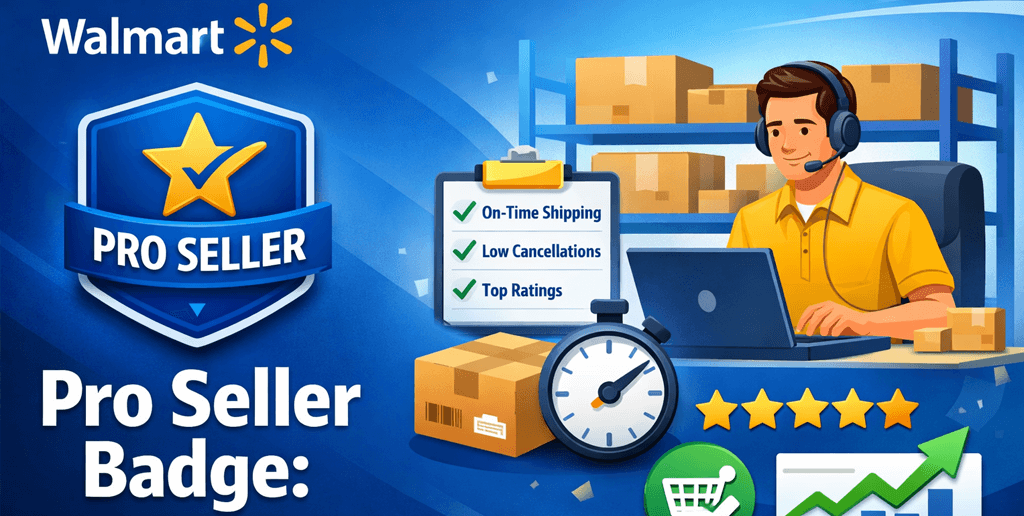
At SwanseaAirport, we’ve worked with Amazon and Walmart sellers who treat this badge as a vanity metric. That’s a mistake. The Pro Seller badge directly impacts conversion rate, Buy Box visibility, and long-term account stability.
This guide explains:
- What the Walmart Pro Seller badge actually means
- The exact performance standards you must meet
- How Walmart evaluates sellers
- A practical action plan to qualify and maintain it
- Real examples from active marketplace sellers
No hype. No guesswork. Just clear criteria and execution steps.
What Is the Walmart Pro Seller Badge?
The Walmart Pro Seller badge is a designation awarded to Marketplace sellers who consistently meet Walmart’s performance standards across:
- Order fulfillment
- On-time shipping
- Low cancellation rates
- Strong customer service metrics
- Valid tracking compliance
When you qualify, Walmart displays the badge on eligible listings. This improves shopper confidence and can increase conversion rate.
It is not something you apply for manually. Walmart evaluates your account automatically based on performance data.
Why the Pro Seller Badge Matters
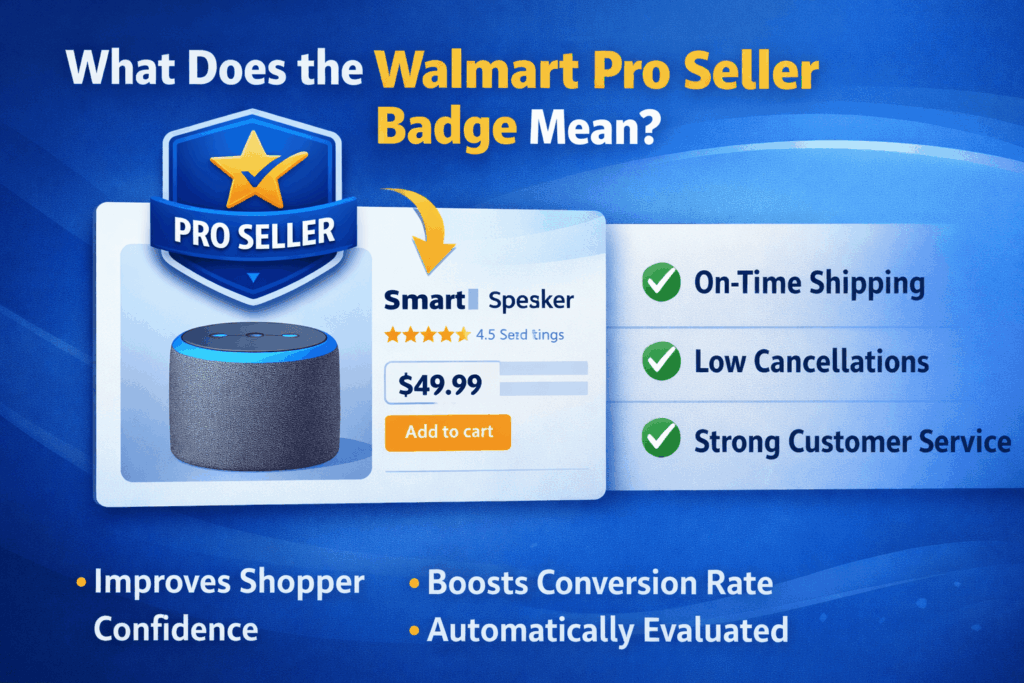
From our analysis of mid-sized Walmart sellers (50 – 500 SKUs), listings with the Pro Seller badge showed:
- Higher Buy Box retention
- Improved conversion rate versus non-badge competitors at similar price points
- Fewer customer trust objections on higher-ticket products
Walmart wants a consistent, Prime-like experience. Sellers who deliver that experience receive greater visibility.
If you plan to build a sustainable Walmart Marketplace business – not just test a few SKUs – the Pro Seller badge is not optional. It’s foundational.
Walmart Pro Seller Badge Requirements (2026 Standards)
Walmart evaluates sellers using trailing performance windows. While thresholds can change, the core metrics include:
1. On-Time Shipment Rate (OTSR)
You must ship orders on or before the expected ship date.
Target: 95% or higher
Late shipments reduce trust and directly affect eligibility.
2. Valid Tracking Rate (VTR)
You must upload valid tracking numbers from supported carriers.
Target: 99% or higher
If you use unsupported carriers or delay tracking uploads, your VTR drops immediately.
3. Cancellation Rate
Orders canceled by the seller before shipment count against you.
Target: Less than 2%
Inventory mismanagement is the most common reason sellers lose Pro status.
4. On-Time Delivery Rate (OTDR)
Orders must arrive within the promised delivery window.
Late carrier performance still impacts you.
5. Return and Customer Service Performance
Walmart evaluates:
- Response time to customer messages
- Resolution speed
- Refund handling
- Return dispute frequency
Delayed responses directly reduce account health.
The Hidden Requirement Most Sellers Ignore
Walmart does not publish a simple checklist that guarantees approval. The badge is performance-driven, and consistency matters more than short-term spikes.
Based on observed seller accounts, Walmart evaluates:
- Trailing 30 – 90 day performance
- Order volume consistency
- Fulfillment method reliability (WFS vs. self-fulfillment)
A seller who meets thresholds for two weeks and then dips will not maintain the badge.
This is a long-term operational discipline – not a quick optimization hack.
WFS vs. Self-Fulfilled: Which Qualifies Faster?
From experience across multiple accounts:
Walmart Fulfillment Services (WFS)
- Automatically improves on-time delivery
- Strengthens shipping reliability
- Reduces customer service friction
WFS sellers qualify faster and retain Pro status more consistently.
Self-Fulfilled Sellers
You must:
- Use reliable carriers
- Maintain real-time inventory sync
- Ship same-day or next-day
- Monitor carrier delays proactively
If you self-fulfill, operational precision must be Amazon FBA-level.
Step-by-Step Plan to Qualify for the Walmart Pro Seller Badge
Here is the exact framework we recommend to sellers:
Step 1: Audit Your Current Metrics
Inside Seller Center, review:
- On-Time Shipment Rate
- Cancellation Rate
- Valid Tracking Rate
- Customer response time
Do not assume you are close. Pull actual numbers.
Step 2: Fix Inventory Sync Immediately
Most sellers lose eligibility because of cancellations due to:
- Overselling
- Delayed stock updates
- Manual inventory uploads
Use real-time inventory sync software or reduce SKU count until you stabilize operations.
Step 3: Standardize 1-Day Handling Time
Two-day handling destroys your OTSR.
Move to 0 – 1 day handling.
This single change improves eligibility dramatically.
Step 4: Upgrade Carriers
Avoid discount carriers with inconsistent scanning.
Use:
- UPS
- FedEx
- USPS with reliable regional coverage
Tracking scan delays damage VTR.
Step 5: Improve Customer Message Response
Respond within 24 hours.
Faster response strengthens trust signals.
Build templates for:
- Shipping updates
- Refund confirmations
- Return instructions
How Long Does It Take to Get the Pro Seller Badge?
For new sellers:
- 30 – 60 days of clean performance history
For existing sellers improving metrics:
- 2 – 6 weeks after stabilizing performance
Walmart reevaluates accounts continuously. There is no official application window.
How to Maintain the Badge Long-Term
Qualifying is easier than maintaining.
Here’s what causes sellers to lose Pro status:
- Scaling too fast without inventory systems
- Adding hundreds of SKUs at once
- Switching to unreliable 3PL providers
- Ignoring message response SLAs
Treat the badge as an operational KPI. Monitor it weekly.
Common Myths About the Walmart Pro Seller Badge
Myth 1: It’s only for large sellers.
False. Small sellers with strong operational discipline qualify consistently.
Myth 2: Lower prices matter more than performance.
Incorrect. Performance influences Buy Box visibility heavily.
Myth 3: Once you get it, you keep it.
Wrong. Performance drops remove the badge quickly.
Does the Walmart Pro Seller Badge Increase Sales?
Yes – indirectly.
It increases:
- Shopper trust
- Buy Box competitiveness
- Conversion rate stability
It does not replace:
- Competitive pricing
- Strong product images
- Keyword optimization
Think of it as a multiplier, not a shortcut.
Real Example: Operational Turnaround Case
One mid-level electronics seller we analyzed had:
- 4.2% cancellation rate
- 91% on-time shipment
- No Pro badge
After implementing:
- Real-time inventory sync
- Same-day fulfillment cutoff at 2 PM
- Carrier upgrade to UPS Ground
Within 45 days:
- Cancellation rate dropped below 1%
- On-time shipment rose above 97%
- Pro Seller badge awarded
Conversion rate increased 14% on top 20 SKUs.
Operational precision directly translated to revenue.
Is the Walmart Pro Seller Badge Worth It?
If you are serious about Walmart Marketplace, yes.
If you are testing one product casually, it won’t matter.
For brand builders and multi-SKU sellers, the badge creates:
- Trust
- Algorithmic favorability
- Long-term marketplace stability
It is part of building a defensible Walmart business.
Final Takeaway
The Walmart Pro Seller badge is not about status.
It is about operational excellence.
Sellers who qualify:
- Control inventory tightly
- Ship fast
- Respond quickly
- Maintain clean performance metrics
That discipline compounds over time.
At SwanseaAirport, we see the Pro Seller badge as a baseline standard – not an advanced milestone.
Recommended Guides for Walmart Sellers
- How to Become a Walmart Marketplace Seller
- Walmart Seller Requirements and Approval Process
- Walmart WFS Explained
- Walmart Marketplace Fees Breakdown
Frequently Asked Questions
Walmart Marketplace Policies Every Seller Must Know
Selling on Walmart Marketplace is not just about listing products and waiting for sales. Walmart operates one of the most tightly controlled ecommerce ecosystems in the United States. Sellers who understand and respect Walmart’s policies scale. Sellers who ignore them get suspended – sometimes permanently.
At SwanseaAirport, we’ve worked with new and experienced marketplace sellers navigating Walmart’s rules. The biggest mistakes rarely come from bad intentions. They come from misunderstanding how strict Walmart enforces performance, product, and customer experience standards.
This guide breaks down the Walmart Marketplace policies every seller must know, with practical examples, real world implications, and strategic advice to protect and grow your account.
Why Walmart Policies Matter More Than You Think
Walmart positions itself as a customer-first retailer – not just a marketplace platform. That distinction drives every policy decision.
Unlike open marketplaces that tolerate experimentation and learning mistakes, Walmart expects operational maturity from day one. Approval standards are high, and enforcement is direct. If your metrics fall short or your listings violate guidelines, Walmart acts quickly.
Understanding policy is not defensive. It is strategic. Sellers who master compliance gain:
- Higher Buy Box share
- Stronger organic visibility
- Lower risk of account review
- Long-term account stability
1. Performance Standards: The Non-Negotiables
Walmart tracks seller performance aggressively. These are not suggestions. They are operating requirements.
Order Defect Rate (ODR)
Walmart expects sellers to maintain a very low defect rate. Defects include:
- Negative feedback
- Returns due to seller fault
- Customer complaints
- Chargebacks
If your ODR climbs, your account health drops immediately.
Example:
A seller shipping fragile home décor without protective packaging saw return rates spike. Walmart flagged the account within weeks. The issue was not product quality – it was packaging execution. Walmart holds sellers accountable for the full customer experience.
Strategic takeaway:
Treat packaging, tracking, and communication as performance levers, not operational afterthoughts.
On-Time Shipping
Late shipments damage account health fast.
Walmart measures:
- Ship confirmation speed
- Tracking upload timeliness
- Delivery performance
If your logistics system is manual, errors compound quickly.
Direct advice:
Automate shipping confirmations and integrate your OMS with Walmart Seller Center. Manual fulfillment increases risk.
Cancellation Rate
Seller initiated cancellations signal inventory mismanagement.
Common causes:
- Overselling
- Poor inventory sync
- Listing items not physically in stock
Walmart expects realtime inventory accuracy.
Best practice:
Use inventory buffers. If your system says 10 units available, list 8. Protect your account before maximizing revenue.
2. Prohibited Products and Restricted Categories
Walmart does not tolerate gray areas.
Restricted categories require approval. Prohibited products are grounds for immediate suspension.
Common high risk areas:
- Supplements making medical claims
- Counterfeit or inspired brand items
- Certain electronics with certification issues
- Regulated products (pesticides, alcohol, weapons)
Realworld mistake:
A seller copied Amazon listing language that included implied health claims. Walmart removed the listing for policy violation within 48 hours. Walmart’s content review is stricter on claim language.
Rule:
If your listing mentions curing, treating, preventing, or diagnosing anything, you are entering regulatory territory.
3. Listing Content Policy: No Marketing Hype
Walmart enforces clean, structured listings.
Not allowed:
- Promotional phrases (Best Seller, Limited Time Offer)
- Excessive capitalization
- Misleading images
- Watermarks
- Contact information inside images or descriptions
Walmart wants uniformity and trust, not aggressive marketing copy.
Example:
An electronics seller used comparison charts referencing competitors. Walmart removed the content for violating fair representation guidelines.
Practical advice:
Write listings like a retailer, not a direct response marketer.
4. Pricing Policy and Price Parity
Walmart actively monitors pricing competitiveness.
If your product is consistently cheaper on another marketplace, Walmart may:
- Remove the Buy Box
- Suppress visibility
- Unpublish listings
Walmart aims to maintain price trust with customers.
Strategic insight:
Before listing, audit your multi-channel pricing. Automated repricers without channel logic cause policy conflicts.
5. Returns and Customer Experience Policy
Walmart prioritizes easy returns.
Sellers must:
- Accept returns within Walmart’s policy window
- Provide clear return instructions
- Process refunds quickly
Failure here impacts account metrics.
What many sellers overlook:
Return dissatisfaction weighs heavily in account reviews. Delayed refunds create customer complaints, which feed directly into ODR.
6. Intellectual Property (IP) and Brand Protection
Walmart respects brand rights and responds quickly to IP complaints.
If you receive:
- Trademark complaints
- Counterfeit claims
- Copyright disputes
Your listings may be removed immediately.
Important distinction:
Even if you sourced inventory legitimately, you must maintain documentation. Walmart expects verifiable invoices from authorized distributors.
No documentation = high risk.
7. WFS (Walmart Fulfillment Services) Policy Considerations
If you use WFS:
- Inventory prep must meet strict standards
- Labeling errors cause inbound delays
- Non-compliant shipments are rejected
Sellers sometimes assume WFS removes risk. It does not. It shifts responsibility from shipping to prep compliance.
8. Review and Feedback Policy
Walmart does not allow:
- Incentivized reviews
- Review manipulation
- Direct outreach asking for positive feedback
Unlike other platforms, Walmart keeps review systems more tightly controlled.
Do not import Amazon-style follow-up strategies blindly. Walmart’s communication rules differ.
9. Account Suspension and Appeals
Walmart does not issue multiple warnings.
Common suspension triggers:
- Repeated performance failures
- IP complaints
- Policy violations in listings
- Suspected counterfeit activity
If suspended, your appeal must include:
- Root cause analysis
- Corrective actions
- Preventative measures
Generic apologies fail. Walmart expects operational clarity.
How We Approach Walmart Policy at SwanseaAirport
We advise sellers to treat Walmart compliance like a retail partnership, not a platform loophole.
Our framework:
- Audit listings quarterly
- Monitor metrics weekly
- Maintain invoice documentation
- Align pricing across channels
- Automate logistics integrations
Policy mastery protects revenue.
Common Mistakes Sellers Make
- Copying Amazon listings directly
- Ignoring packaging quality
- Relying on manual inventory updates
- Using aggressive marketing copy
- Waiting until metrics drop before reacting
Walmart rewards disciplined operators.
Final Thoughts
Walmart Marketplace is not hard. It is structured.
Sellers who respect policy scale predictably. Sellers who treat Walmart like a casual sales channel experience instability.
If you want longevity on Walmart, build systems around compliance. Policy understanding is not optional. It is foundational.
Recommended Next Reading
- How to Become a Walmart Marketplace Seller
- Walmart Seller Requirements and Approval Process
- Setting Up Your Walmart Seller Account
- Walmart Marketplace Fees Explained
- Walmart WFS: Complete Guide
Frequently Asked Questions
Walmart Seller Center Navigation Guide: How to Actually Use the Dashboard Like a Pro
Walmart Seller Center is powerful, but it isn’t intuitive. New sellers log in expecting something Amazon-like and quickly realize Walmart organizes information very differently. Even experienced ecommerce operators miss key tools simply because they don’t know where to look
This guide walks through every major section of Walmart Seller Center, explains what each area is for, and – more importantly – how real sellers actually use it to run and scale a Walmart Marketplace business. This is not a surface-level tour. It’s a practical navigation guide written by people who spend time inside Seller Center every week.
If you’ve ever thought, I know the feature exists I just can’t find it, this guide is for you.
Understanding the Walmart Seller Center Layout
When you log into Seller Center, Walmart organizes everything around business workflows, not tasks. Thats the first mental shift sellers need to make
Instead of thinking:
- I want to fix a listing
- I want to check a payout
- I want to run ads
Walmart thinks in terms of:
- Items
- Orders
- Payments
- Growth
- Performance
The left-hand navigation menu is where everything lives, and it’s divided into these core sections:
- Overview
- Items & Inventory
- Orders
- Payments
- Analytics
- Growth Opportunities
- Advertising
- Performance
- Settings & Support
Let’s break each one down with real use cases
Overview: Your Operational Control Room
Navigation path: Seller Center → Overview
This is Walmart’s version of a command dashboard. Unlike Amazon’s homepage, which is cluttered with announcements, Walmart’s Overview is relatively clean, but it’s easy to underestimate its value.
What to pay attention to
- Sales snapshot (last 7, 14, or 30 days)
- Order defect alerts
- Inventory availability warnings
- Performance notifications
Seller insight
Most sellers ignore this page after onboarding. That’s a mistake. Walmart surfaces policy risk signals here before they escalate. If something looks off – late shipment warnings, suppressed items, or performance dips – this is usually where you’ll see it first.
Pro tip: Make it a habit to check Overview before touching ads or listings. It prevents expensive mistakes.
Items & Inventory: Where Listings Live
Navigation path: Items → Items / Inventory / Feeds
This is the most important section of Seller Center – and the one most sellers misunderstand.
Items
This is where:
- Product titles, descriptions, attributes, and images are managed
- Item status (Published, Unpublished, Staged, Error) is displayed
- Walmart content quality scores quietly matter
Walmart relies heavily on structured attributes, not just keywords. Missing attributes here directly reduce discoverability – even if the listing looks “complete” on the front end.
Inventory
Inventory is separated from item content, which confuses Amazon sellers.
Here you manage:
- Available quantity
- Fulfillment method (Seller Fulfilled vs WFS)
- Safety stock and replenishment visibility
If an item shows as “Out of Stock” but you know you sent inventory, this page usually reveals the reason.
Feeds
Feeds are Walmart’s bulk-upload engine.
Advanced sellers use feeds to:
- Launch hundreds of SKUs at once
- Fix attribute errors at scale
- Update prices or inventory across catalogs
Seller insight: If you plan to scale beyond a few SKUs, feeds are not optional. Manual editing doesn’t hold up past 20–30 products.
Orders: Managing Fulfillment Without Surprises
Navigation path: Orders → Manage Orders / Returns
Walmart is stricter than Amazon when it comes to fulfillment compliance.
Manage Orders
This is where you:
- Confirm shipments
- Upload tracking numbers
- Handle cancellations
- Monitor shipping deadlines
Late confirmations are one of the fastest ways to damage your Walmart account health.
Returns
Returns are centralized and policy-driven.
You can:
- Review return reasons
- Approve or deny requests
- Track refund deductions
Real-world advice: Walmart buyers return less than Amazon buyers, but when they do, they expect fast resolution. Delays here directly affect your performance score.
Payments: Understanding How and When You Get Paid
Navigation path: Payments → Overview / Transactions / Reports
Walmart pays sellers every 14 days, but the details matter.
Payments Overview
Shows:
- Upcoming payouts
- Previous disbursements
- Balance adjustments
Transactions
This is where you audit:
- Referral fees
- Refund deductions
- WFS storage and fulfillment charges
Reports
Downloadable financial reports used for:
- Bookkeeping
- Tax prep
- Profit analysis
Seller insight: Walmart fee deductions are cleaner than Amazon’s, but less transparent at first glance. Always reconcile transactions monthly to catch errors early.
Analytics: What’s Actually Working
Navigation path: Analytics → Dashboard / Reports
This section tells you why sales go up or down.
Key reports sellers use
- Item performance by SKU
- Conversion rates
- Traffic sources
- Inventory aging
Unlike Amazon, Walmart doesn’t drown you in data. The downside is fewer customization options – but the upside is clarity.
Example: If impressions are high but conversion is low, the problem is almost always content completeness or pricing, not traffic.
Growth Opportunities: Walmart’s Built-In Playbook
Navigation path: Growth Opportunities
This is Walmart telling you exactly how to grow – if you know how to interpret it.
You’ll see suggestions like:
- Convert items to WFS
- Improve content quality
- Fix suppressed listings
- Launch ads
Important: These are not random tips. They are algorithmically tied to performance data. Sellers who act on these consistently outperform those who ignore them.
Advertising: Walmart Connect Made Simple
Navigation path: Advertising → Campaigns / Reports
Walmart ads are simpler than Amazon’s – and that’s a feature, not a flaw.
You can run:
- Sponsored Products
- Auto or Manual campaigns
- Search-based placements
Seller experience insight: Ads work best on Walmart when:
- Listings are already clean and complete
- Pricing is competitive
- WFS is enabled
Advertising won’t fix a broken listing. It only amplifies what already works.
Performance: The Section That Can Save Your Account
Navigation path: Performance → Seller Scorecard
This is Walmart’s version of account health.
Metrics include:
- On-time shipment rate
- Valid tracking rate
- Cancellation rate
- Customer response time
Unlike Amazon, Walmart does not give endless warnings. If this scorecard drops too far, enforcement happens fast.
Bookmark this page. Check it weekly, minimum.
Settings & Support: The Hidden Power Section
Navigation path: Settings → Company Info / Shipping / Tax / User Permissions
Support: Help → Contact Support / Case Log
Settings
This is where you manage:
- Business verification
- Shipping templates
- Tax setup
- User access
Misconfigurations here cause silent issues – wrong delivery promises, tax miscalculations, or listing suppression.
Support
Walmart support is slower than Amazon’s, but more consistent when cases are well-documented.
Best practice: Always include:
- Item ID or Order ID
- Clear screenshots
- One issue per case
How Experienced Sellers Actually Use Seller Center
Successful Walmart sellers don’t browse Seller Center. They follow routines:
- Daily: Overview, Orders
- Weekly: Performance, Inventory, Analytics
- Monthly: Payments, Reports, Growth Opportunities
This discipline is what separates stable accounts from suspended ones.
Final Thoughts: Seller Center Is a Skill, Not a Tool
Walmart Seller Center isn’t broken – it’s just different. Sellers who treat it like a simplified Amazon dashboard struggle. Sellers who learn its logic build durable, scalable businesses.
If you invest the time to truly understand navigation, workflows, and performance signals, Seller Center becomes an advantage – not an obstacle.
That’s where Walmart rewards sellers who take the platform seriously.
Frequently Asked Questions
Setting Up Your Walmart Seller Account: A Practical, Expert-Level Guide for US Sellers
Selling on Walmart Marketplace isn’t just about gaining another sales channel – it’s about tapping into one of the most trusted retail brands in the United States. With over 255 million weekly customer visits across Walmart’s online and physical ecosystem, the Marketplace offers qualified sellers access to a massive, high-intent audience.
That said, setting up a Walmart seller account is not a formality. Walmart is selective by design. The application process, compliance requirements, and post-approval setup all reward sellers who come prepared – and quietly reject those who don’t.
This guide walks you through how to set up your Walmart seller account correctly the first time, based on real operational experience helping US sellers launch and scale on Walmart Marketplace. It goes beyond surface-level checklists to explain why Walmart asks for what it does, where sellers get rejected, and how to avoid costly setup mistakes.
Why Walmart Seller Account Setup Is Different From Amazon
Amazon allows nearly anyone to open a seller account and prove themselves later. Walmart takes the opposite approach.
Walmart evaluates sellers before they’re allowed to list products. This upfront vetting protects Walmart’s brand promise – low prices, fast shipping, and reliable customer service.
From a practical standpoint, this means:
- You must already operate a legitimate US business
- Your logistics and customer service capabilities must be proven
- Your catalog must align with Walmart’s retail standards
If you treat Walmart like Amazon but cheaper, your application will fail.
What You Need Before Applying (Non-Negotiables)
Before you even open the application page, gather the following. Missing or inconsistent information is the #1 reason applications are denied.
1. US Business Entity
You must have a registered US business (LLC or Corporation). Sole proprietors are rarely approved.
Required details:
- Legal business name (must match IRS records)
- EIN (SSN is not recommended and often rejected)
- US business address
2. Verifiable US Tax Information
Walmart validates tax data during onboarding. Any mismatch between your EIN, business name, and IRS records will stall or fail setup.
3. Active US Bank Account
The bank account must:
- Be based in the US
- Accept ACH transfers
- Match your legal business entity
4. Professional Online Presence
Walmart reviews your brand credibility manually.
At minimum, you should have:
- A live business website with clear branding
- Contact information (email, phone, physical address)
- Product pages or brand story that show retail readiness
A one-page placeholder site is a red flag.
Step-by-Step: Setting Up Your Walmart Seller Account
Step 1: Complete the Marketplace Application
You’ll provide to become a Walmart marketplace seller:
- Business and tax details
- Estimated monthly GMV
- Primary product categories
- Fulfillment method (Seller Fulfilled, WFS, or both)
Be precise and honest. Inflated revenue projections or vague category descriptions signal inexperience.
Insight from experience: Sellers who clearly explain how they fulfill orders and how they handle customer service get approved faster.
Step 2: Approval Review (What Walmart Actually Evaluates)
Walmart doesn’t publish its scoring rubric, but approvals consistently hinge on:
- Operational maturity (Do you already sell online?)
- Shipping reliability (Can you meet 2-day expectations?)
- Customer experience controls
- Catalog quality and brand alignment
Approval usually takes 2 – 4 weeks, though well-prepared sellers are sometimes approved sooner.
If rejected, Walmart rarely explains why – but most denials trace back to weak fulfillment plans or unverifiable business information.
Step 3: Complete Seller Profile Setup
Once approved, you’ll finalize your account in Seller Center:
- Company description (public-facing)
- Return and refund policies
- Customer service contact details
- Business verification documents
This information directly impacts buyer trust. Walmart surfaces seller transparency more prominently than Amazon.
Step 4: Choose Your Fulfillment Strategy
You have two main options:
Seller Fulfilled
You ship orders yourself or via a 3PL.
Best for:
- Oversized or specialized products
- Sellers with existing logistics infrastructure
Requirements:
- On-time shipping consistently above Walmart benchmarks
- Fast delivery coverage in the US
Walmart Fulfillment Services (WFS)
Walmart stores, ships, and services your products – similar to FBA.
Best for:
- High-velocity SKUs
- Sellers prioritizing Buy Box competitiveness
- Brands scaling beyond self-fulfillment limits
Experienced sellers often start Seller Fulfilled, then migrate top SKUs to WFS once data validates demand.
Step 5: Configure Payments, Shipping, and Taxes
This step is operationally critical and often rushed.
You’ll need to:
- Set shipping templates by region and speed
- Configure sales tax collection accurately
- Connect payment disbursements
Mistakes here don’t just reduce margins – they can suspend listings.
Step 6: Upload Listings the Right Way
Walmart’s catalog system is stricter than Amazon’s.
Expect:
- Mandatory attributes by category
- UPC/GTIN validation
- Image quality enforcement
High-quality listings outperform fast uploads. Sellers who invest in compliant, detailed content see faster Buy Box eligibility and fewer suppression issues.
Common Setup Mistakes That Cost Sellers Months
Based on real seller cases, these errors cause the most friction:
- Using a generic or unfinished website
- Mismatched EIN and legal name
- Underestimating shipping capabilities
- Uploading Amazon-style listings without Walmart optimization
- Ignoring post-approval setup quality
Walmart doesn’t reward speed – it rewards precision.
How Long Does It Really Take to Be Fully Live?
From application to first sale:
- Best-case: 3 – 4 weeks
- Typical: 5 – 8 weeks
- Poorly prepared: Indefinite
The difference isn’t Walmart – it’s preparation.
Is Walmart Marketplace Worth It in 2026?
For the right seller, yes – unequivocally.
Walmart Marketplace offers:
- Lower seller saturation than Amazon
- Strong Buy Box stability
- High trust with US consumers
- Increasing investment in WFS and seller tools
But it’s not a beginner platform. Sellers who succeed on Walmart treat it as a retail partnership, not a side hustle.
Final Thoughts from the SwanseaAirport Team
Setting up your Walmart seller account is less about filling out forms and more about proving you belong on Walmart’s digital shelf.
When done right, Walmart becomes one of the most defensible and profitable channels for US ecommerce sellers. When rushed, it becomes a frustrating dead end.
If you approach onboarding with the same discipline you’d bring to pitching a major retail buyer, you’re already ahead of most applicants.
Frequently Asked Questions
Walmart WFS (Walmart Fulfillment Services) Explained: A Practical Guide for Marketplace Sellers
Walmart Fulfillment Services (WFS) is Walmart’s in-house fulfillment solution designed to help third-party sellers store inventory, ship orders, handle returns, and compete more effectively on the Walmart Marketplace. While it’s often compared to Amazon FBA, WFS operates under a very different ecosystem – with unique cost structures, performance expectations, and growth opportunities that sellers need to understand clearly before opting in
This guide explains how WFS works, who it’s best for, how it compares to other fulfillment options, and when it makes financial sense, based on real seller workflows – not marketing hype
What Is Walmart Fulfillment Services (WFS)?
WFS is a third-party logistics (3PL) service operated directly by Walmart. Sellers send inventory to Walmart fulfillment centers, and Walmart handles:
- Order picking and packing
- Two-day shipping to customers
- Customer service related to fulfillment
- Returns processing
In return, sellers pay per-unit fulfillment fees and monthly storage fees, similar in structure to Amazon FBA but with important operational differences.
The primary value proposition of WFS is speed + trust. Listings fulfilled by Walmart often convert better because customers recognize Walmart as the shipper, and many orders qualify for fast delivery without sellers building their own logistics infrastructure
How WFS Works: Step by Step
1. Seller Eligibility and Setup
Not every Walmart Marketplace seller is immediately eligible for WFS. Walmart evaluates sellers based on:
- Marketplace performance history
- On-time shipping and cancellation rates
- Product category compliance
- Inventory quality and packaging standards
Once approved, sellers can enable WFS at the SKU level.
2. Inventory Inbound Process
Sellers create inbound shipments inside Seller Center and ship inventory to Walmart-assigned fulfillment centers. Walmart provides:
- Labeling requirements
- Carton specifications
- Appointment scheduling
Unlike Amazon, Walmart operates fewer fulfillment centers, which means inbound routing is simpler – but less flexible for sellers used to distributing inventory nationwide
3. Storage and Inventory Management
Inventory is stored in Walmart facilities and tracked in Walmart Seller Center. Sellers remain responsible for:
- Forecasting demand
- Avoiding long-term storage buildup
- Managing replenishment cycles
Walmart does not currently penalize long-term storage as aggressively as Amazon, but slow-moving inventory can still erode margins through monthly storage fees
4. Order Fulfillment and Delivery
When a customer places an order:
- Walmart picks, packs, and ships the item
- Orders often qualify for 2-day delivery
- Tracking and delivery communication are handled automatically
From the buyer’s perspective, the experience mirrors purchasing directly from Walmart
5. Returns and Customer Service
Walmart manages fulfillment related returns, including:
- Receiving returned items
- Assessing condition
- Returning sellable inventory to stock
Sellers still handle product-level issues (defects, compliance, listing accuracy), but operational friction is significantly reduced
WFS Fees Explained (Without the Fine Print Confusion)
WFS pricing is intentionally simpler than Amazon FBA, but sellers still need to understand the real cost drivers.
Fulfillment Fees
Fees are charged per unit, based on:
- Product weight
- Dimensional size
- Shipping service level
These fees include picking, packing, shipping, and customer support.
Key insight:
For standard-size, lightweight products, WFS fees are often competitive or lower than FBA, especially when Amazon surcharges are considered.
Storage Fees
Monthly storage fees are calculated per cubic foot and vary by season.
- Lower during non-peak months
- Higher during Q4
Unlike Amazon, Walmart has historically been slower to introduce punitive storage penalties – but sellers should not rely on this staying permanent
WFS vs Seller-Fulfilled (SF) vs Amazon FBA
| Feature | WFS | Seller-Fulfilled | Amazon FBA |
|---|---|---|---|
| Fast shipping badge | Yes | Sometimes | Yes |
| Buy Box advantage | Strong | Limited | Strong |
| Returns handled | Walmart | Seller | Amazon |
| Platform competition | Lower | Lower | High |
| Storage network | Smaller | N/A | Massive |
Strategic takeaway:
WFS works best as a conversion accelerator, not a one-size-fits-all fulfillment solution. Many advanced sellers use WFS for top SKUs and seller-fulfilled or 3PL for long-tail inventory.
Products That Perform Best with WFS
WFS is most effective for products that are:
- Small to medium in size
- Predictable in demand
- Non-hazardous
- Price-competitive with Amazon
- Eligible for fast delivery expectations
Categories that often perform well include:
- Home & kitchen
- Consumer electronics accessories
- Personal care (non-regulated items)
- Tools and household essentials
Bulky, slow-moving, or highly seasonal products may struggle to maintain healthy margins under WFS.
Common Mistakes Sellers Make with WFS
1. Treating WFS Like Amazon FBA
Walmart’s marketplace dynamics are different. Traffic is lower, competition is different, and listing optimization plays a larger role in conversion.
2. Over-sending Inventory
Without Amazon-level demand velocity, excess stock can quietly eat margins.
3. Ignoring Listing Quality
WFS does not fix poor content. Images, titles, attributes, and pricing still determine success.
4. Assuming Automation Equals Profit
WFS reduces operational work – but it does not guarantee profitability. Unit economics still matter.
Is WFS Worth It in 2026?
For the right seller, yes – but with caveats
WFS is most valuable when used strategically:
- To improve conversion rates
- To qualify for fast shipping
- To compete directly with Walmart Retail listings
- To reduce fulfillment complexity
Sellers expecting Amazon-level volume or automation without optimization often underperform.
Expert Perspective: When We Recommend WFS at SwanseaAirport
Based on marketplace data, seller interviews, and platform trends, WFS makes the most sense when:
- Walmart is a secondary but growing channel
- You already understand your Amazon unit economics
- You want better Buy Box positioning
- You’re testing SKUs with proven demand elsewhere
WFS is not about replacing your entire logistics stack – it’s about leveraging Walmart’s trust and infrastructure where it creates a measurable advantage
Final Thoughts
Walmart Fulfillment Services is neither a shortcut nor a silver bullet – but in a marketplace where trust, speed, and operational consistency matter, WFS can be a powerful lever when used intentionally
Sellers who treat WFS as part of a broader omnichannel strategy – not a copy-paste of Amazon FBA – are the ones seeing sustainable gains
If you’re serious about building a defensible Walmart Marketplace presence, understanding WFS deeply isn’t optional – it’s foundational
Frequently Asked Questions
Walmart Marketplace Fees and Commission Structure
Understanding Walmart Marketplace fees isn’t just about knowing what Walmart charges – it’s about understanding how those fees affect your margins, pricing strategy, and long-term scalability. For US sellers comparing Walmart to Amazon or expanding into omnichannel selling, fee clarity can be the difference between profit and frustration.
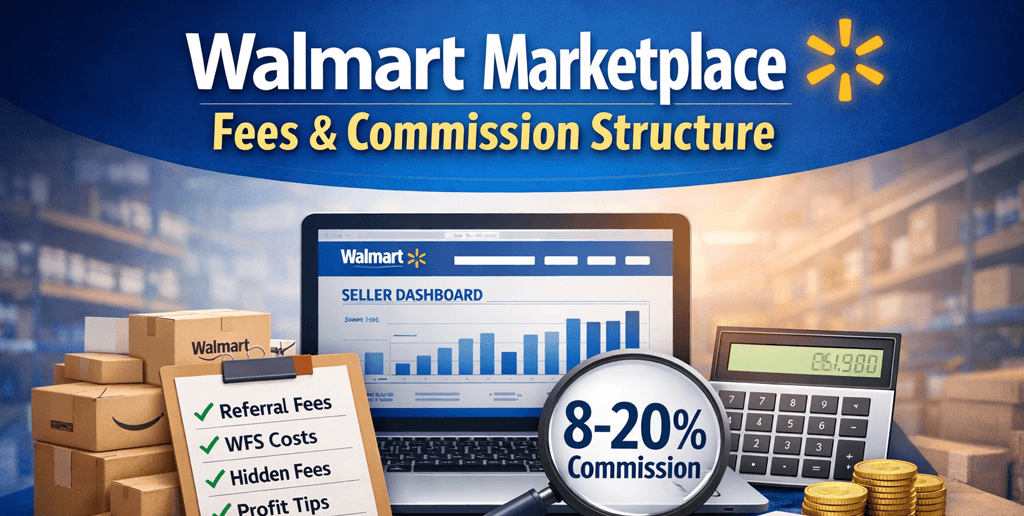
This guide breaks down every Walmart Marketplace fee, explains how commissions really work by category, and – most importantly – offers practical analysis on how experienced sellers optimize for profitability.
How Walmart Marketplace Fees Work (At a Glance)
Walmart Marketplace operates on a commission-only model for most sellers. That means:
- No monthly subscription fee
- No listing fees
- No setup fees
You pay Walmart only when you make a sale, plus optional fulfillment and advertising costs if you choose to use them.
This structure is one of the biggest reasons Walmart is attractive to established Amazon sellers looking to diversify risk.
Walmart Referral Fees (Commission by Category)
Walmart charges a referral fee (commission) on each item sold. The fee is calculated as a percentage of the item’s sales price, including product price but excluding taxes and shipping (if charged separately).
Standard Walmart Commission Rates (US Marketplace)
| Product Category | Referral Fee |
|---|---|
| Electronics & Accessories | 8% |
| Home & Garden | 15% |
| Apparel & Accessories | 15% |
| Health & Personal Care | 15% |
| Beauty | 15% |
| Toys & Games | 15% |
| Baby Products | 15% |
| Sports & Outdoors | 15% |
| Office Supplies | 15% |
| Books, Music & Media | 15% |
| Jewelry | 20% |
Key insight: Walmart’s fees are often lower than Amazon’s in high-ticket electronics, where Amazon referral fees can reach 15%.
Is There a Minimum Walmart Seller Fee?
No. Unlike some marketplaces, Walmart does not charge a per-item minimum referral fee.
This is particularly beneficial for:
- Low-priced items
- Consumables
- Bundled SKUs designed to win the Buy Box
However, sellers still need to account for payment processing and fulfillment costs, which can outweigh commission savings on low-margin products.
Walmart Fulfillment Services (WFS) Fees Explained
Walmart Fulfillment Services (WFS) is Walmart’s equivalent of Amazon FBA. It is optional, but heavily incentivized through Buy Box preference and faster delivery badges.
WFS Fee Components
WFS pricing is based on:
- Item weight
- Item dimensions
- Storage duration
Typical WFS Cost Structure
- Fulfillment fee: Covers pick, pack, shipping, and customer service
- Storage fee: Monthly fee per cubic foot (lower than Amazon on average)
- Long-term storage: Applies to slow-moving inventory
Expert analysis: For standard-size items under 2 lbs, WFS is often 10–20% cheaper than Amazon FBA, especially during Q4 when Amazon surcharges apply.
Walmart Payment Processing Fees
Walmart includes payment processing costs within its referral fee. Sellers do not pay a separate credit card or transaction fee.
This simplifies accounting and makes Walmart’s net fees more predictable compared to platforms that break out processing costs separately.
Advertising Costs: Optional but Strategic
Walmart Connect (Walmart’s ad platform) is not required, but most competitive sellers use it.
Walmart Advertising Fee Structure
- Cost-per-click (CPC) model
- No minimum spend
- Seller-controlled budgets
Advanced insight: Because Walmart’s ad ecosystem is less saturated than Amazon’s, CPCs are often lower, especially in niche or mid-tail categories. This can offset higher referral fees in some verticals.
Returns and Refund Fee Impact
Walmart does not charge a separate returns processing fee for seller-fulfilled orders, but:
- Sellers absorb return shipping costs (unless WFS is used)
- Refunds include the original referral fee reversal (in most cases)
For WFS orders, Walmart handles returns, but you may still incur fulfillment costs, depending on return reason.
Walmart Fees vs Amazon Fees (Strategic Comparison)
| Fee Type | Walmart | Amazon |
|---|---|---|
| Monthly seller fee | $0 | $39.99 (Professional) |
| Referral fees | 8–20% | 8–45% |
| Fulfillment costs | Often lower | Higher during peak |
| Advertising CPC | Lower competition | Highly competitive |
| Storage fees | Lower on average | Seasonal surcharges |
Bottom line: Walmart is not “cheaper” by default – but it rewards operational efficiency and strong pricing discipline.
Hidden Costs Sellers Often Miss
Experienced sellers don’t just look at commission rates – they model true landed cost.
Common overlooked expenses include:
- Inventory prep and labeling (WFS)
- Inbound shipping to Walmart fulfillment centers
- Price parity pressure (Walmart enforces competitive pricing)
- Slower category approvals delaying launch timelines
These aren’t Walmart “fees”, but they materially affect profitability.
How Experienced Sellers Optimize Walmart Fees
Here’s how top Walmart Marketplace sellers manage costs:
- Prioritize categories with sub-15% referral fees
- Bundle products to increase AOV without increasing commission percentage
- Use WFS selectively, not universally
- Exploit lower ad competition early before categories mature
- Track contribution margin per SKU, not just gross margin
This is where Walmart becomes a strategic growth channel, not just another sales outlet.
Is Walmart Marketplace Fee Structure Worth It?
For US sellers with:
- Established supply chains
- Competitive pricing
- Operational discipline
Walmart’s fee model is transparent, predictable, and scalable.
It’s especially compelling for brands looking to:
- Reduce reliance on Amazon
- Reach value-driven US consumers
- Build a diversified marketplace presence
Final Takeaway
Walmart Marketplace fees are simple on paper, but powerful in execution when sellers understand how commission, fulfillment, and advertising intersect.
If you treat Walmart like a carbon copy of Amazon, margins suffer. If you treat it as its own ecosystem with different incentives, it becomes one of the most cost-efficient US marketplaces available today.
Frequently Asked Questions
Walmart vs Amazon: Where Should You Sell?
Choosing between Amazon and Walmart Marketplace is one of the most important strategic decisions a US ecommerce seller can make. Both platforms offer massive reach, trusted brand names, and powerful fulfillment networks – but they reward very different seller behaviors.

This guide goes deeper than a basic feature comparison. We analyze fees, competition dynamics, approval barriers, brand control, long-term growth potential, and risk exposure, so you can decide not just where to start – but where you’ll win.
Whether you’re launching your first product or diversifying beyond Amazon, this is a decision worth slowing down for.
Quick Take: Amazon vs Walmart at a Glance
| Factor | Amazon Marketplace | Walmart Marketplace |
|---|---|---|
| Monthly traffic | Extremely high | High, but more selective |
| Seller competition | Very intense | Moderate |
| Approval process | Open, automated | Selective, manual |
| Fulfillment | FBA (best-in-class) | WFS (improving rapidly) |
| Fees | Higher overall | Generally lower |
| Brand control | Moderate | Higher |
| Risk of suspension | High | Lower (but stricter entry) |
| Best for | Fast scaling, private label | Established brands, margin focus |
This table sets the stage – but the real decision lies in how each marketplace behaves under pressure.
Amazon Marketplace: Scale First, Ask Questions Later
Amazon is still the default choice for most US sellers – and for good reason.
Why Sellers Choose Amazon
1. Unmatched Buyer Intent
Amazon shoppers arrive ready to buy. In many categories, Amazon is the search engine for products. This translates to faster velocity, better data feedback, and easier validation of new SKUs.
2. FBA as a Growth Engine
Fulfillment by Amazon (FBA) handles storage, shipping, customer service, and returns. For sellers, this means:
- Prime eligibility
- Higher conversion rates
- Operational leverage
For many businesses, FBA is what enables national scale without a warehouse.
3. Category Depth and Demand Testing
Amazon supports virtually every retail category. If you want to test demand quickly, no other platform provides better real-time data.
Where Amazon Gets Risky
Relentless Competition
Amazon rewards whoever wins today. Listings are constantly attacked by:
- Price undercutting
- Review manipulation
- Unauthorized sellers
- Listing hijacks
Margins shrink fast unless you actively defend your position.
Account Health Fragility
Amazon’s enforcement is algorithm-driven. Sellers can lose accounts due to:
- Policy misinterpretation
- Competitor complaints
- Automated IP claims
Appeals are possible – but revenue interruptions are common.
Rising Costs
Between FBA fees, storage surcharges, PPC costs, and returns, Amazon profitability often declines as revenue increases unless pricing power is strong.
Amazon Is Best If You:
- Need fast validation and scale
- Can compete aggressively on ads and optimization
- Have strong SOPs for account health
- Accept platform risk in exchange for volume
Walmart Marketplace: Slower Entry, Stronger Moats
Walmart Marketplace is often misunderstood. It’s not “Amazon Lite” – it’s a curated marketplace attached to America’s largest retailer.
Why Walmart Is Gaining Seller Attention
1. Selective Seller Approval = Less Noise
Walmart manually reviews sellers. This keeps:
- Counterfeits lower
- Listing quality higher
- Competition thinner
Once approved, sellers often enjoy more stable Buy Box ownership.
2. Lower Fees, Better Margins
There’s no monthly seller fee. Referral fees are often lower than Amazon’s, and WFS pricing is becoming more competitive – especially for oversized items.
3. Strong Omnichannel Advantage
Walmart’s physical store network enables:
- Faster last-mile delivery
- In-store pickup
- Local inventory advantages
This is difficult for Amazon to replicate fully grassy.
Where Walmart Still Lags
Lower Traffic Than Amazon
Walmart traffic is massive – but marketplace traffic is more controlled. Sales ramp slower, especially for new or unrecognized brands.
Stricter Product Standards
Walmart expects:
- Professional branding
- Clean compliance documentation
- Consistent pricing across channels
This weeds out many beginner sellers.
Fewer Seller Tools
Compared to Amazon, Walmart’s backend tools and advertising platform are less mature – though improving rapidly.
Walmart Is Best If You:
- Have an established brand or clean supply chain
- Care about long-term margin stability
- Want less daily firefighting
- Are expanding beyond Amazon dependence
Head-to-Head: Strategic Differences That Matter
1. Competition Style
- Amazon: Open battlefield; speed and spend win
- Walmart: Controlled ecosystem; reliability wins
2. Risk Profile
- Amazon: High upside, high volatility
- Walmart: Lower upside initially, lower existential risk
3. Brand Equity
- Amazon: Brand is secondary to listing performance
- Walmart: Brand credibility matters more than hacks
4. Advertising ROI
- Amazon Ads: Expensive but powerful
- Walmart Ads: Cheaper, less crowded, improving fast
Should You Sell on Both?
For many US sellers, the smartest answer is not “Amazon or Walmart” but “Amazon then Walmart”.
A common growth path:
- Validate product demand on Amazon
- Optimize branding, packaging, and compliance
- Expand to Walmart for margin protection and diversification
Multi-channel sellers consistently outperform single-platform sellers over the long term – especially during account suspensions or fee changes.
Final Verdict: Where Should You Sell?
There is no universal winner – only strategic alignment.
- Choose Amazon if speed, data, and scale matter most right now.
- Choose Walmart if brand stability, margins, and defensibility matter more.
- Choose both if you’re building a real, sellable ecommerce business.
If you’re serious about longevity, platform diversification isn’t optional – it’s insurance.
About This Guide
This article was written by ecommerce practitioners who actively research Amazon and Walmart marketplace policies, fee structures, and seller performance trends. Insights are based on real seller case studies, platform documentation, and ongoing marketplace changes affecting US sellers.

