
Selling on Walmart Marketplace isn’t just about gaining another sales channel – it’s about tapping into one of the most trusted retail brands in the United States. With over 255 million weekly customer visits across Walmart’s online and physical ecosystem, the Marketplace offers qualified sellers access to a massive, high-intent audience.
That said, setting up a Walmart seller account is not a formality. Walmart is selective by design. The application process, compliance requirements, and post-approval setup all reward sellers who come prepared – and quietly reject those who don’t.
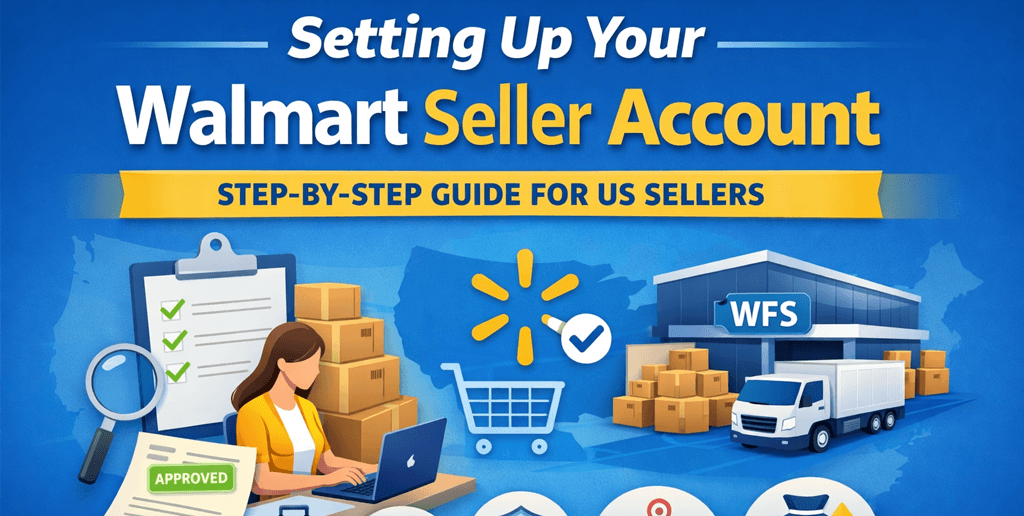
This guide walks you through how to set up your Walmart seller account correctly the first time, based on real operational experience helping US sellers launch and scale on Walmart Marketplace. It goes beyond surface-level checklists to explain why Walmart asks for what it does, where sellers get rejected, and how to avoid costly setup mistakes.
Why Walmart Seller Account Setup Is Different From Amazon
Amazon allows nearly anyone to open a seller account and prove themselves later. Walmart takes the opposite approach.
Walmart evaluates sellers before they’re allowed to list products. This upfront vetting protects Walmart’s brand promise – low prices, fast shipping, and reliable customer service.
From a practical standpoint, this means:
- You must already operate a legitimate US business
- Your logistics and customer service capabilities must be proven
- Your catalog must align with Walmart’s retail standards
If you treat Walmart like Amazon but cheaper, your application will fail.
What You Need Before Applying (Non-Negotiables)
Before you even open the application page, gather the following. Missing or inconsistent information is the #1 reason applications are denied.
1. US Business Entity
You must have a registered US business (LLC or Corporation). Sole proprietors are rarely approved.
Required details:
- Legal business name (must match IRS records)
- EIN (SSN is not recommended and often rejected)
- US business address
2. Verifiable US Tax Information
Walmart validates tax data during onboarding. Any mismatch between your EIN, business name, and IRS records will stall or fail setup.
3. Active US Bank Account
The bank account must:
- Be based in the US
- Accept ACH transfers
- Match your legal business entity
4. Professional Online Presence
Walmart reviews your brand credibility manually.
At minimum, you should have:
- A live business website with clear branding
- Contact information (email, phone, physical address)
- Product pages or brand story that show retail readiness
A one-page placeholder site is a red flag.
Step-by-Step: Setting Up Your Walmart Seller Account
Step 1: Complete the Marketplace Application
You’ll provide to become a Walmart marketplace seller:
- Business and tax details
- Estimated monthly GMV
- Primary product categories
- Fulfillment method (Seller Fulfilled, WFS, or both)
Be precise and honest. Inflated revenue projections or vague category descriptions signal inexperience.
Insight from experience: Sellers who clearly explain how they fulfill orders and how they handle customer service get approved faster.
Step 2: Approval Review (What Walmart Actually Evaluates)
Walmart doesn’t publish its scoring rubric, but approvals consistently hinge on:
- Operational maturity (Do you already sell online?)
- Shipping reliability (Can you meet 2-day expectations?)
- Customer experience controls
- Catalog quality and brand alignment
Approval usually takes 2 – 4 weeks, though well-prepared sellers are sometimes approved sooner.
If rejected, Walmart rarely explains why – but most denials trace back to weak fulfillment plans or unverifiable business information.
Step 3: Complete Seller Profile Setup
Once approved, you’ll finalize your account in Seller Center:
- Company description (public-facing)
- Return and refund policies
- Customer service contact details
- Business verification documents
This information directly impacts buyer trust. Walmart surfaces seller transparency more prominently than Amazon.
Step 4: Choose Your Fulfillment Strategy
You have two main options:
Seller Fulfilled
You ship orders yourself or via a 3PL.
Best for:
- Oversized or specialized products
- Sellers with existing logistics infrastructure
Requirements:
- On-time shipping consistently above Walmart benchmarks
- Fast delivery coverage in the US
Walmart Fulfillment Services (WFS)
Walmart stores, ships, and services your products – similar to FBA.
Best for:
- High-velocity SKUs
- Sellers prioritizing Buy Box competitiveness
- Brands scaling beyond self-fulfillment limits
Experienced sellers often start Seller Fulfilled, then migrate top SKUs to WFS once data validates demand.
Step 5: Configure Payments, Shipping, and Taxes
This step is operationally critical and often rushed.
You’ll need to:
- Set shipping templates by region and speed
- Configure sales tax collection accurately
- Connect payment disbursements
Mistakes here don’t just reduce margins – they can suspend listings.
Step 6: Upload Listings the Right Way
Walmart’s catalog system is stricter than Amazon’s.
Expect:
- Mandatory attributes by category
- UPC/GTIN validation
- Image quality enforcement
High-quality listings outperform fast uploads. Sellers who invest in compliant, detailed content see faster Buy Box eligibility and fewer suppression issues.
Common Setup Mistakes That Cost Sellers Months
Based on real seller cases, these errors cause the most friction:
- Using a generic or unfinished website
- Mismatched EIN and legal name
- Underestimating shipping capabilities
- Uploading Amazon-style listings without Walmart optimization
- Ignoring post-approval setup quality
Walmart doesn’t reward speed – it rewards precision.
How Long Does It Really Take to Be Fully Live?
From application to first sale:
- Best-case: 3 – 4 weeks
- Typical: 5 – 8 weeks
- Poorly prepared: Indefinite
The difference isn’t Walmart – it’s preparation.
Is Walmart Marketplace Worth It in 2026?
For the right seller, yes – unequivocally.
Walmart Marketplace offers:
- Lower seller saturation than Amazon
- Strong Buy Box stability
- High trust with US consumers
- Increasing investment in WFS and seller tools
But it’s not a beginner platform. Sellers who succeed on Walmart treat it as a retail partnership, not a side hustle.
Final Thoughts from the SwanseaAirport Team
Setting up your Walmart seller account is less about filling out forms and more about proving you belong on Walmart’s digital shelf.
When done right, Walmart becomes one of the most defensible and profitable channels for US ecommerce sellers. When rushed, it becomes a frustrating dead end.
If you approach onboarding with the same discipline you’d bring to pitching a major retail buyer, you’re already ahead of most applicants.
Leave a Reply