
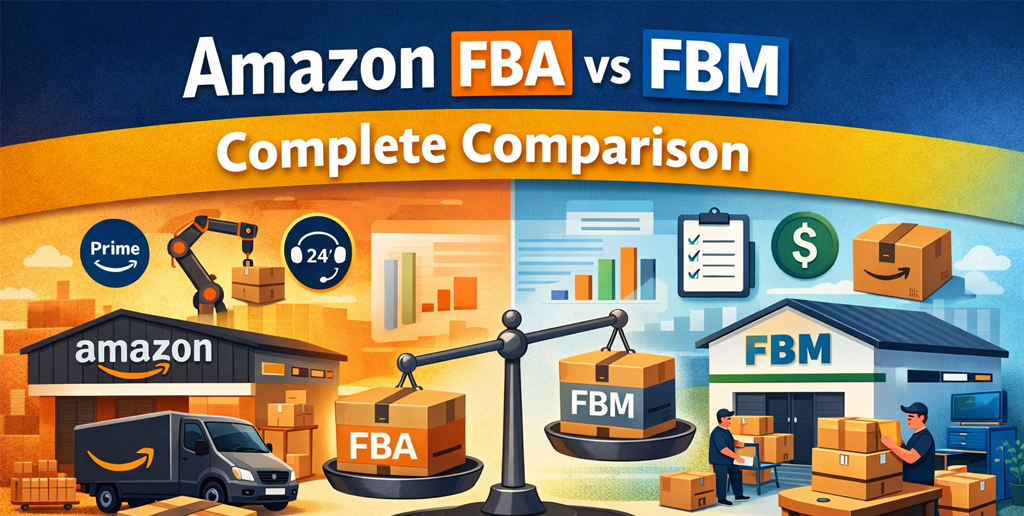
Selling on Amazon is no longer just about finding the right product – it’s about choosing the right fulfillment strategy. One of the first and most important decisions sellers must make is whether to use Amazon FBA (Fulfillment by Amazon) or FBM (Fulfillment by Merchant)
Choosing between FBA and FBM is one of the most important decisions new sellers face. If you’re building your foundation, explore our complete Amazon Seller Guides hub for step-by-step help with account setup, fees, compliance, and product selection
At SwanseaAirport, we work closely with Amazon and Walmart sellers at every stage – from first-time entrepreneurs to established brands scaling across marketplaces. This guide is designed to give you a clear, honest, and comprehensive comparison of Amazon FBA vs FBM, so you can choose the model that best fits your business goals, margins, and operational capacity
This isn’t a surface-level summary. It’s a practical decision guide you can bookmark, reference, and share
What Is Amazon FBA?
Fulfillment by Amazon (FBA) means Amazon stores your inventory, picks and packs orders, ships products to customers, and handles customer service and returns on your behalf.
How FBA Works
- You send inventory to Amazon fulfillment centers
- Customers place orders on Amazon
- Amazon handles shipping, delivery, returns, and customer support
- You pay fulfillment, storage, and service fees
Why Sellers Choose FBA
- Prime eligibility (2-day and same-day delivery)
- Higher Buy Box win rate
- Less operational workload
- Amazon-managed customer trust
SwanseaAirport Insight:
For US shoppers, Prime is often the default filter. In competitive categories, FBA isn’t just a convenience – it’s a conversion advantage.
What Is Amazon FBM?
Fulfillment by Merchant (FBM) means you store inventory, pack orders, ship them to customers, and handle customer service and returns.
How FBM Works
- You list products on Amazon
- Orders are routed to your warehouse, 3PL, or dropship partner
- You manage shipping, tracking, customer service, and returns
Why Sellers Choose FBM
- Lower fees for large, heavy, or slow-moving items
- Full control over branding and packaging
- Easier integration with multi-channel fulfillment
- Better cash flow control for some sellers
SwanseaAirport Insight:
FBM is often misunderstood as “manual” or “beginner-level”. In reality, many seven-figure brands use FBM strategically, especially when margins matter more than speed.
Amazon FBA vs FBM: Side-by-Side Comparison
| Feature | Amazon FBA | Amazon FBM |
|---|---|---|
| Fulfillment | Amazon handles everything | Seller handles fulfillment |
| Prime Badge | Yes | No (unless Seller Fulfilled Prime) |
| Buy Box Advantage | Strong | Moderate |
| Fees | Higher, predictable | Lower, variable |
| Storage | Amazon warehouses | Seller or 3PL |
| Customer Service | Amazon | Seller |
| Returns | Amazon-managed | Seller-managed |
| Branding Control | Limited | Full |
| Scalability | Easy | Requires logistics planning |
Cost Comparison: FBA vs FBM (Beyond the Obvious)
Many articles stop at “FBA costs more”. That’s incomplete.
Amazon FBA Costs Include:
- Fulfillment fees (size + weight based)
- Monthly storage fees
- Long-term storage penalties
- Prep and labeling fees (if applicable)
Amazon FBM Costs Include:
- Warehousing or home storage
- Shipping (carrier-dependent)
- Labor or 3PL fees
- Packaging and branded inserts
- Customer service resources
SwanseaAirport Analysis:
The true cost difference depends on:
- Product size and weight
- Order velocity
- Return rate
- Seasonality
For example:
- A small, fast-moving item often performs better with FBA
- A bulky, slow-moving product may be more profitable with FBM
FBA includes storage and fulfillment fees in addition to referral fees. See our complete Amazon seller fees breakdown and calculator to estimate total costs.
Buy Box & Conversion Impact
Amazon’s algorithm heavily favors:
- Fast shipping
- Strong customer experience
- Reliable order fulfillment
FBA Advantage
- Automatically qualifies for Prime
- Amazon trusts its own logistics
- Higher Buy Box win rates in competitive niches
- Amazon reimbursement service
FBM Reality
- Can still win the Buy Box
- Requires excellent metrics (on-time shipping, low cancellation rate)
- Seller Fulfilled Prime can close the gap – but with strict requirements
Expert Tip from SwanseaAirport:
If you’re launching a new product in a saturated category, FBA often accelerates traction. FBM works best when you already have demand or differentiation.
Inventory Control & Risk Management
FBA Risks
- Long-term storage fees
- Inventory stranded or delayed
- Limited flexibility during Q4 congestion
- Less control over returns handling
- amazon shipping delays
FBM Advantages
- Full inventory visibility
- Easier liquidation or bundle strategies
- Faster response to demand changes
- Better for test launches or limited runs
SwanseaAirport Insight:
Advanced sellers often use a hybrid strategy – FBA for bestsellers, FBM for long-tail SKUs. And if you don’t know how to start, you can check how to start selling on Amazon to know more tips about it!
Customer Experience & Brand Control
If brand building matters to you, this section matters.
FBA Limitations
- Generic Amazon packaging
- Limited brand touchpoints
- Amazon controls customer communication
FBM Advantages
- Custom packaging
- Inserts and brand storytelling
- Direct customer support experience
This is especially important for:
- DTC-focused brands
- Subscription products
- Repeat-purchase categories
If you’re scaling with FBA, forming an LLC may offer liability protection. See our guide on the Best states to register your Amazon business LLC
Which Is Better: Amazon FBA or FBM?
Choose FBA If:
- You want faster scaling
- Your product is small and lightweight
- Prime eligibility is critical
- You prefer automation over control
Choose FBM If:
- Margins are tight
- Products are oversized or fragile
- You sell across Amazon, Walmart, and your own site
- Brand experience matters
Best Option for Many Sellers:
👉 Use both.
Many successful sellers optimize profitability by mixing FBA and FBM based on SKU performance. Both fulfillment methods are available under the Professional plan. If you’re unsure which plan to choose, read our guide to Amazon seller account types: Individual vs Professional
Expert Perspective: How SwanseaAirport Helps Sellers Decide
At SwanseaAirport, we don’t recommend FBA or FBM blindly. We help sellers:
- Model real fulfillment costs
- Analyze category competition
- Align fulfillment with long-term brand strategy
- Prepare for Amazon and Walmart marketplace expansion
Our guides, tools, and product reviews are designed to help sellers make confident, data-driven decisions – not follow trends.
Final Thoughts
Amazon FBA vs FBM isn’t about which model is “better”. It’s about which model is better for your business at this stage.
A well-informed fulfillment decision can:
- Improve margins
- Reduce operational stress
- Increase Buy Box ownership
- Support long-term brand growth
If this guide helped clarify your strategy, it’s doing exactly what it was designed to do.
Leave a Reply