
Selling on Amazon offers massive opportunity – but it also comes with strict rules. One of the most common roadblocks sellers face is Amazon restricted categories, often referred to as “gated categories.” If you’ve ever seen the message “You need approval to list in this category”, you’ve encountered Amazon gating firsthand.
Navigating restricted categories is a key compliance challenge for many sellers – if you’re new to Amazon selling, start with our Amazon Seller Guides hub to understand every stage from setup to scaling.
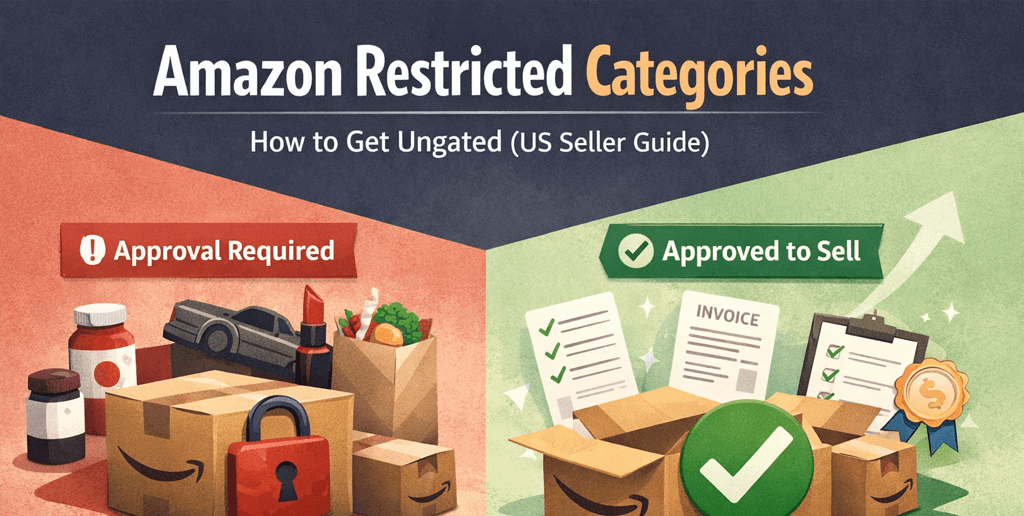
Understanding gating requirements fits into the broader process of launching your Amazon business — see how to start selling on Amazon in 2026 before diving into restricted categories.
This guide explains what Amazon restricted categories are, why they exist, which categories are gated in the US marketplace, and – most importantly – how to get ungated step by step. Drawing on real seller experience, Amazon policy analysis, and approval best practices, this article goes beyond surface-level advice to help you increase your approval success rate.
What Are Amazon Restricted (Gated) Categories?
Amazon restricted categories are product categories or brands that require explicit approval from Amazon before you’re allowed to list and sell. Unlike open categories (such as Books or Home & Kitchen), gated categories have additional compliance, quality, and authenticity requirements.
Amazon gates categories to:
- Protect customers from counterfeit or unsafe products
- Ensure sellers meet regulatory and legal standards
- Reduce fraud, chargebacks, and customer complaints
- Maintain brand trust and marketplace integrity
Key insight: Gating is not about limiting sellers – it’s about limiting risk. Sellers who demonstrate professionalism and compliance are far more likely to be approved.
Common Amazon Restricted Categories (US Marketplace)
While Amazon updates gating rules frequently, the following categories are commonly restricted in the US:
1. Grocery & Gourmet Food
- Requires food safety compliance
- Expiration date tracking
- FDA-regulated products
2. Health & Personal Care
- Supplements, medical devices, topical products
- Often requires FDA documentation or lab testing
3. Beauty & Skincare
- High counterfeit risk
- Requires manufacturer invoices and brand authorization
4. Automotive & Powersports
- Safety-critical components
- VIN compatibility and liability concerns
5. Jewelry
- High value, fraud risk
- Authenticity verification
6. Collectible Coins & Fine Art
- Requires proof of authenticity and condition grading
7. Sexual Wellness Products
- Strict content and safety guidelines
8. Topical or Brand-Level Gating
- Nike, Apple, Adidas, Lego, and other major brands
- Even if the category is open, specific brands may be restricted
Pro tip: Category approval ≠ brand approval. You may be approved for Beauty but still blocked from selling a gated brand within that category.
Why Amazon Gating Changes Over Time
One overlooked reality is that Amazon gating is dynamic. Categories can move from open → gated (or vice versa) based on:
- Increased counterfeit reports
- Regulatory pressure (FDA, CPSC, FTC)
- Customer safety incidents
- Brand enforcement requests
This is why seller strategies that worked two years ago may no longer work today.
For private label sellers, holding a registered brand can simplify getting approved – find out how Amazon Brand Registry helps with gated access and brand protection.
How to Check If a Category or Product Is Restricted
Before sourcing inventory, always verify eligibility:
Method 1: Add a Product in Seller Central
- Go to Inventory → Add a Product
- Enter the ASIN or product name
- If approval is required, Amazon will display a “Request Approval” button
Method 2: Use Amazon Seller App
Scan a barcode and check eligibility instantly – especially useful for retail arbitrage.
Method 3: Category-Level Check
Navigate to Seller Central → Help → Categories and Products Requiring Approval
Many gated categories require a Professional seller plan or business documentation – learn about the difference between Individual and Professional plans to choose the right setup.
How to Get Ungated on Amazon (Step-by-Step)
Getting ungated is a documentation and credibility exercise, not a trick. Here’s how to approach it strategically.
Step 1: Identify the Exact Approval Type
Amazon approvals typically fall into three types:
- Category approval
- Brand approval
- Product-level approval (ASIN-specific)
Each requires different documentation.
Step 2: Prepare the Required Documents
While requirements vary, Amazon commonly asks for:
1. Commercial Invoices (Most Critical)
Invoices must:
- Be issued within the last 90 days
- Include seller name & address (must match Seller Central)
- Include supplier name, address, phone number
- List minimum quantity (often 10+ units)
- Show product name clearly matching the ASIN
Original insight: Many rejections happen not because invoices are fake – but because product naming doesn’t match Amazon’s catalog exactly.
2. Supplier Verification
Amazon prefers:
- Authorized distributors
- Manufacturers
- Well-established wholesalers
Avoid:
- Retail receipts
- Alibaba proforma invoices
- Screenshots or PDFs without supplier contact details
3. Compliance & Safety Documents (If Required)
Depending on category:
- FDA registration
- COA (Certificate of Analysis)
- MSDS / SDS
- Product testing reports
- Images of packaging and labels
Step 3: Submit a Clean, Professional Application
When submitting:
- Upload clear, unedited PDFs
- Do not crop or blur invoices
- Ensure consistency across all documents
- Avoid unnecessary explanations unless asked
Advanced tip: Over-explaining often triggers manual review and delays approval.
Step 4: Respond Strategically to Rejections
Rejections are common – even for legitimate sellers.
If denied:
- Read the rejection reason carefully
- Fix only what Amazon flagged
- Resubmit with corrected documents
- Avoid resubmitting identical files
Persistence + precision matters more than volume.
Amazon often requires specific documentation to get ungated – see our guide on required documents for Amazon registration to prepare ahead of time.
Common Reasons Sellers Get Denied (And How to Avoid Them)
| Reason for Denial | How to Fix It |
|---|---|
| Retail receipts | Use wholesale invoices only |
| Invoice mismatch | Match ASIN title exactly |
| Supplier unverifiable | Use established distributors |
| Old invoices | Ensure <90 days |
| Insufficient quantity | Meet Amazon’s minimum |
Is Getting Ungated Worth It?
From a long-term business perspective – yes.
Benefits of Selling in Gated Categories
- Less competition
- Higher profit margins
- Better Buy Box stability
- Reduced race-to-the-bottom pricing
- Increased brand trust with customers
For wholesale and private label sellers, ungating is often the gateway to scalable, defensible listings.
Expert Perspective: How Top Sellers Stay Ungated
Experienced sellers don’t chase ungating randomly. They:
- Source after checking eligibility
- Build relationships with authorized suppliers
- Maintain clean documentation systems
- Avoid policy gray areas
- Treat Amazon like a compliance-first platform
This mindset – not hacks – is what sustains seven-figure Amazon businesses.
Some restricted niches have specific criteria that make products easier or harder to scale – refer to our guide on Amazon product criteria to apply smart filters.
Restricted categories may favor certain models (wholesale vs private label vs arbitrage) – see our business model comparison guide to decide which path fits your goals.
Final Thoughts
Amazon restricted categories are not barriers – they’re filters. Sellers who understand Amazon’s risk framework, compliance expectations, and documentation standards consistently outperform those looking for shortcuts.
If your goal is to build a long-term, defensible Amazon business, learning how to navigate restricted categories is not optional – it’s foundational.
At SwanseaAirport, we focus on helping sellers make informed, compliant decisions that scale. Mastering ungating is one of the clearest signals that you’re operating like a professional seller – not a temporary reseller.
Leave a Reply