
Amazon PPC isn’t broken – but many campaign structures are.
After auditing hundreds of Amazon ad accounts across private-label brands, resellers, and seven-figure operators, one pattern shows up again and again: poor campaign structure is the hidden tax on ad spend. Sellers blame high ACoS, low ROAS, or “Amazon ads being expensive”, when the real issue is that their campaigns were never designed to scale, isolate performance, or support decision-making.
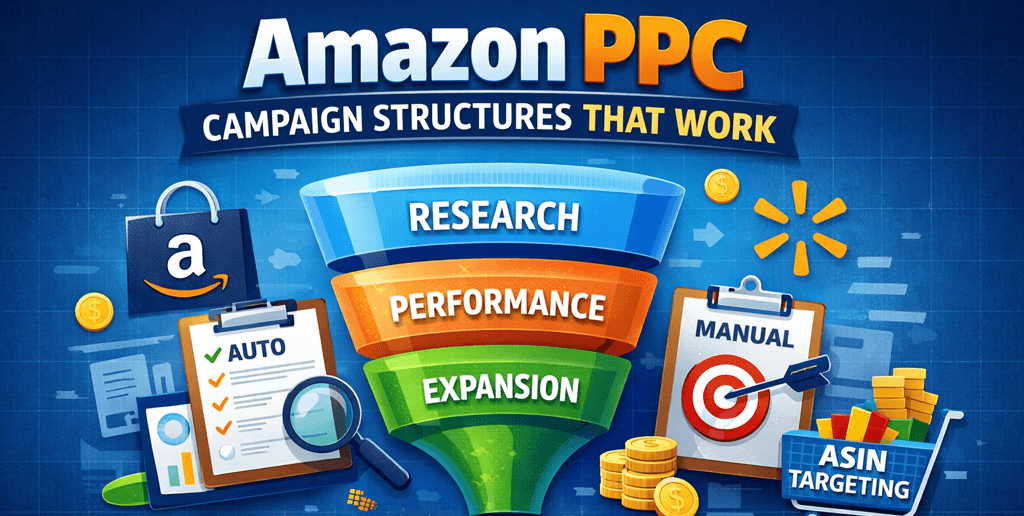
This guide breaks down Amazon PPC campaign structures that actually work in 2026, why they work, and how experienced sellers structure accounts for control, efficiency, and long-term profitability.
This is not a recycled SKAG checklist. It’s a practical framework you can bookmark, share, and implement.
Why Campaign Structure Matters More Than Bids
Before diving into structures, it’s important to understand why structure matters at all.
A good Amazon PPC structure allows you to:
- Identify which keywords and ASINs drive profit
- Control bids without guesswork
- Prevent internal keyword cannibalization
- Scale winners while containing waste
- Make optimization decisions based on clean data – not averages
A bad structure hides performance signals, forces you to overbid defensively, and turns optimization into guesswork.
In short: structure determines clarity, and clarity determines profit.
The Core Principle: One Variable Per Decision
High-performing Amazon PPC accounts follow a simple but powerful rule:
Each campaign should answer one question clearly.
For example:
- Is this keyword profitable?
- Does this ASIN convert against competitors?
- Is this search term brand-defensive or exploratory?
When campaigns mix match types, intents, and targeting methods, you lose the ability to answer those questions.
Everything that follows builds on this principle.
Structure #1: The Research → Performance Funnel (Modern Auto + Manual)
This is the most reliable foundation for new products and mature listings.
Step 1: Auto Campaign (Research Layer)
Purpose: Discover converting search terms and ASIN placements.
Best Practices:
- One auto campaign per parent ASIN
- Split auto targets into four separate ad groups:
- Close match
- Loose match
- Substitutes
- Complements
- Set conservative default bids
- No aggressive bid multipliers initially
Why it works:
Segmenting auto targets reveals where Amazon is finding demand. Close match terms that convert are fundamentally different from substitute ASIN placements – and they should never be optimized the same way.
Step 2: Manual Exact (Profit Layer)
Purpose: Capture proven demand efficiently.
What goes here:
- Only search terms with confirmed conversions
- Exact match only
- Higher bids, tighter control
Key Rule:
Every keyword in exact should be negated from auto and phrase campaigns to prevent overlap.
This isolates performance and ensures your best keywords aren’t inflated by discovery campaigns.
Step 3: Manual Phrase (Expansion Layer)
Purpose: Controlled keyword expansion.
Phrase campaigns sit between auto and exact:
- They allow variation
- They catch long-tails
- They surface new exact candidates
Phrase should never compete with exact. Exact wins every time.
Structure #2: Match-Type Isolation (Why Mixed Match Types Fail)
One of the most common structural mistakes is placing broad, phrase, and exact keywords in the same campaign.
Why This Fails
- Amazon prioritizes broad matches internally
- You can’t see which match type actually converted
- Bid changes affect unrelated traffic
- Search term reports become noisy and misleading
What Works Instead
Create separate campaigns for each match type:
- Exact = efficiency and scaling
- Phrase = controlled discovery
- Broad = limited, data-driven testing only
This structure isn’t about being “clean”. It’s about decision leverage. When performance drops, you know exactly where to act.
Structure #3: ASIN Targeting by Intent (Not One Dump Campaign)
Most sellers treat product targeting as an afterthought. That’s a mistake.
ASIN targeting works best when segmented by intent.
Winning ASIN Campaign Types
1. Competitor ASINs
- Similar price point
- Comparable reviews
- Direct substitutes
2. Premium Competitors
- Higher price
- Strong branding
- Opportunity for value positioning
3. Defensive ASINs
- Your own ASINs
- Variations
- Bundles
Each group behaves differently. Lumping them together hides which placements actually convert – and which only burn spend.
Structure #4: Brand vs Non-Brand Separation
If you sell a brand with any level of recognition, brand keywords must live in their own campaigns.
Why This Matters
- Brand traffic converts differently
- Brand ACoS is artificially low
- Mixing brand and non-brand inflates perceived performance
Without separation, you may think your campaigns are profitable – until you pause ads and watch organic sales collapse.
Best Practice
- Sponsored Products: Brand Exact
- Sponsored Brands: Brand Headline
- Sponsored Display: Brand defense
Treat brand campaigns as revenue protection, not growth engines.
Structure #5: Budget Control by Campaign Role
Budgets should reflect intent, not optimism.
A strong structure assigns budgets based on function:
| Campaign Type | Budget Priority |
|---|---|
| Exact (Top Keywords) | High |
| Brand Defense | Medium |
| Phrase | Medium |
| Auto (Research) | Capped |
| Broad | Low |
This prevents Amazon from overspending on low-intent traffic while starving your best performers.
Advanced Insight: Structure Evolves as the Product Matures
One of the biggest misconceptions is that there’s a “perfect” PPC structure.
In reality, structure evolves:
- Launch phase: Heavier auto + phrase
- Growth phase: Aggressive exact scaling
- Mature phase: ASIN conquesting + efficiency tuning
- Defensive phase: Brand and category lock-in
Expert PPC managers don’t rebuild accounts randomly – they add layers as data accumulates.
Why This Framework Works in the Real World
This approach is based on:
- Hands-on audits of real Amazon ad accounts
- Long-term performance tracking across categories
- Practical constraints sellers face (budgets, time, reporting limits)
It avoids:
- One-size-fits-all templates
- “Set and forget” automation myths
- Over-segmentation that creates management overhead
That balance – between clarity and practicality – is what separates theoretical PPC advice from systems that actually perform.
Final Thoughts: Structure Is Strategy
Amazon PPC success isn’t about finding a secret bid or magic keyword.
It’s about building a structure that tells the truth about your data.
If your campaigns can clearly answer:
- What is working?
- Why it’s working?
- Where to scale safely?
You’ll always outperform sellers chasing hacks.
At SwanseaAirport, we believe great PPC structures don’t just reduce ACoS – they unlock confident decision-making. That’s what scales brands on Amazon and Walmart long term.
Leave a Reply