Finding your first product to sell on Amazon is the most important decision you’ll make as a new seller – and the one that determines whether your business becomes profitable or frustrating.
Finding the right product is one of the most important steps in building a profitable Amazon business. If you’re still setting up your foundation, explore our complete Amazon Seller Guides for help with account creation, fees, and fulfillment decisions.
At SwanseaAirport, we work with Amazon and Walmart sellers every day, and one pattern is consistent: successful sellers don’t start with “what’s popular” – they start with structured product research, real demand data, and clear profit logic.
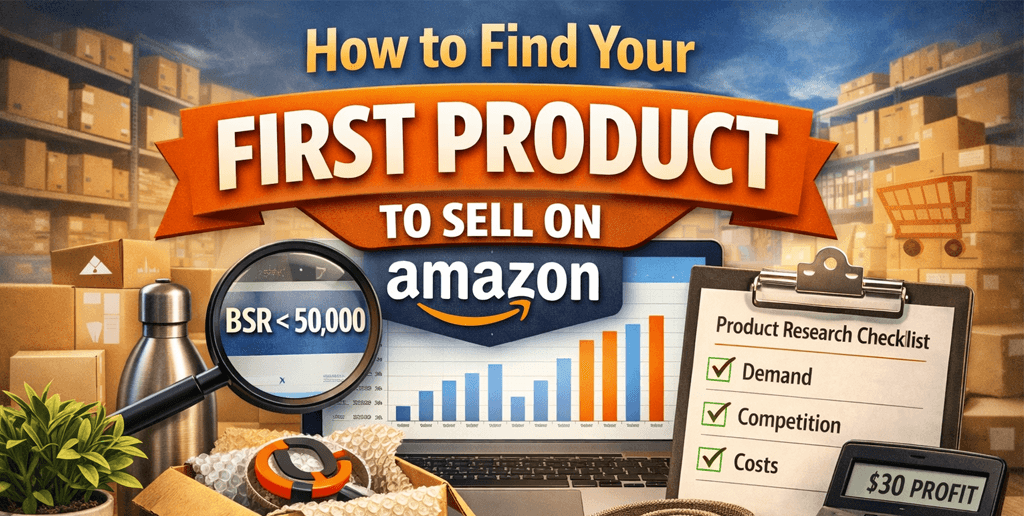
This guide walks you through a repeatable, beginner-friendly framework to find your first Amazon product with confidence. It’s based on real marketplace behavior, seller economics, and practical risk management – not hype or shortcuts.
Why Your First Amazon Product Matters More Than Anything Else
Many new sellers assume they can fix a bad product with better ads, branding, or pricing. In reality:
- Ads cannot fix low demand
- Branding cannot fix razor-thin margins
- Optimization cannot fix intense competition
Your first product sets your learning curve, cash flow, and risk exposure. Choosing wisely lets you:
- Validate Amazon as a business model
- Learn logistics, PPC, and listings without burning capital
- Reinvest profits into scaling rather than recovering losses
Step 1: Start With Demand, Not Ideas
One of the most common beginner mistakes is starting with a product idea instead of market demand.
What Real Demand Looks Like on Amazon
Demand means:
- Customers are actively searching
- Products are selling consistently, not seasonally spiking
- Sales are distributed across multiple sellers, not dominated by one brand
How to Validate Demand (Without Guesswork)
Use Amazon itself as your primary data source:
- Search your product idea
- Look at Best Seller Rank (BSR) across the top 10 listings
- Check if multiple products have:
- BSR under ~50.000 in their category
- Recent reviews (not all from years ago)
- Ongoing stock availability
Insight: If only one listing sells well and the rest barely move, that’s brand dominance – not healthy demand.
Step 2: Choose the Right Product Category for Beginners
Not all Amazon categories are beginner-friendly.
Best Categories for First-Time Sellers
These categories tend to have:
- Predictable demand
- Lower regulatory risk
- Simpler logistics
Recommended:
- Home & Kitchen
- Tools & Home Improvement
- Patio, Lawn & Garden
- Pet Supplies
- Office Products
Categories to Avoid at the Start
Unless you have experience or certifications:
- Grocery & Gourmet Food
- Supplements & Beauty
- Electronics
- Toys (high seasonality + compliance)
- Baby products (safety & liability)
Step 3: Apply the “Beginner Product Filter”
Before moving forward, your product should pass all of these filters.
1. Price Range: $20 to $50
- Below $20 -> margins disappear after fees and ads
- Above $50 -> higher return rates and buyer hesitation
2. Lightweight & Compact
- Ideally under 2 lbs
- Fits in a shoebox-sized package
- Lower FBA fees = higher margin safety
3. No Fragile or Complex Parts
Avoid:
- Glass
- Electronics
- Multiple components that can break or go missing
Rule of thumb: If you’d hesitate to ship it to a friend without bubble wrap anxiety, skip it
Before committing to a product, make sure you understand how Amazon calculates commission, fulfillment, and storage charges
Step 4: Analyze Competition the Right Way (Not Just Review Count)
Many guides say “avoid products with more than 1.000 reviews”. That’s overly simplistic.
What Actually Signals Beat-Able Competition
Look for:
- Listings with poor images or weak branding
- Titles stuffed with keywords but unclear benefits
- Reviews complaining about the same unresolved issues
- Sellers relying only on price discounts
Red Flags to Walk Away
- One brand owning 6 – 8 of the top 10 results
- Heavy Amazon private label presence
- Patented or trademarked designs
- Extremely optimized listings with professional video + storefronts
Step 5: Validate Profitability With Real Numbers
A product that sells well but doesn’t profit is not a business.
Calculate Your True Profit
You must account for:
- Product cost (including packaging)
- Shipping to Amazon
- Amazon FBA fees
- Referral fees
- Advertising (PPC)
- Returns and refunds
Target minimum: 30% net margin after ads
Ideal first product margin: 35 – 40%
This margin buffer protects you while learning Amazon Pay Per Click and ranking mechanics.
Step 6: Improve the Product – Don’t Just Copy It
Successful first products are rarely new inventions. They are better versions of existing demand.
Smart Ways to Differentiate
- Fix the #1 complaint in reviews
- Add a complementary accessory
- Improve instructions or packaging
- Offer better sizing, material, or durability
- Create a clearer use case for a niche audience
Example: Instead of “yoga mat”, position it for “home physical therapy” or “senior balance training”.
This is how small sellers compete with large brands.
Step 7: Validate Suppliers Before You Commit
Before placing any large order:
- Order samples from at least 2 – 3 suppliers
- Compare quality, packaging, and communication
- Confirm lead times and defect handling
- Ask about customization and branding options
Never rely on photos alone. Once you’ve identified a promising opportunity, the next step is finding a reliable manufacturer
Step 8: Start Small and Test the Market
Your first product is a learning investment, not a home-run attempt. Many sellers rely on keyword and trend data tools like helium 10 to evaluate search volume and competition.
Smart Launch Strategy
- Order a small initial quantity
- Launch with conservative PPC
- Monitor conversion rate, returns, and feedback
- Improve listing based on real customer behavior
Scaling comes after validation, not before.
Common First-Product Mistakes (And How to Avoid Them)
| Mistake | Why It Fails |
|---|---|
| Chasing viral products | Short lifespan, extreme competition |
| Copying influencers blindly | Their success ≠ your margins |
| Ignoring fees & ads | Paper profits disappear fast |
| Over-ordering inventory | Cash flow traps beginners |
| Competing on price alone | Race to the bottom |
Final Thoughts: Think Like a Business Owner, Not a Gambler
Finding your first product to sell on Amazon is not about luck – it’s about structured decision-making.
If you can:
- Validate demand
- Control risk
- Build margin safety
- Improve what already works
You give yourself the best possible chance to succeed.
At SwanseaAirport, we believe sustainable Amazon businesses are built with data, discipline, and long-term thinking – not shortcuts. Your first product doesn’t need to be perfect. It just needs to be well-chosen.
Frequently Asked Questions